
Ideas for a better investment
Brokering Notes on Paperstac: What Every Note Broker Should Know
Learn how brokering notes on Paperstac works, including buyer setup, broker fees, compliance rules, and the step-by-step process.

20 min read
Mortgage Note Brokerage Market Context
While mortgage note brokering is a niche within the broader real estate finance ecosystem, it operates inside a multi-trillion-dollar U.S. mortgage market, where banks, funds, and private investors regularly buy and sell loans to manage risk, liquidity, and yield.
As non-performing, re-performing, and performing mortgage notes continue to trade in the secondary market, the role of knowledgeable note brokers has become increasingly important in connecting sellers with qualified buyers.
Note brokers facilitate these secondary market transactions on platforms like Paperstac, earning competitive fees while providing essential due diligence, transaction management, and compliance expertise.
Don’t take a transaction off-platform or “shop” a seller’s asset after agreeing on a price—Paperstac states this violates their terms and can result in removal from the site. Maintaining platform integrity protects all parties and ensures compliant note brokerage transactions.
What Is Note Brokering on Paperstac?
A note broker is a professional intermediary who facilitates mortgage note transactions between sellers and specific buyers.
When you’re brokering notes on Paperstac, you’re not purchasing the note yourself—you’re strategically connecting the right asset to the right buyer based on that buyer’s investment criteria, and earning a broker fee for your expertise.
Unlike traditional mortgage brokers who help borrowers obtain new loans, mortgage note brokers work in the secondary market, facilitating the purchase and sale of existing mortgage debt instruments. This distinction is important in the evolving mortgage brokerage landscape.
Key Components of Note Brokering
- Vesting Profile: The legal purchasing entity that appears on purchase documents (your buyer’s entity, not yours as the broker)
- Escrow and Audit: The recommended closing schedule Paperstac uses for brokered transactions once price is agreed and due diligence is complete
- Broker Fee: Your compensation, typically structured as a percentage (1-3%) or flat dollar amount of the transaction value
- Due Diligence: The comprehensive verification process that protects both buyer and seller in mortgage note transactions
How Mortgage Note Brokers Add Value: As a note broker, you provide essential services including asset sourcing, buyer qualification, due diligence coordination, transaction management, and compliance oversight—all critical functions in the $74.3 billion mortgage brokerage services market.
Buyer Details You Need for Note Brokering
Successful mortgage note brokers work directly with buyers before entering transactions. Paperstac emphasizes knowing your buyer’s criteria thoroughly to ensure you’re sourcing appropriate assets and facilitating smooth transactions.
As a note broker, you must collect comprehensive buyer information to properly match assets, structure transactions, and facilitate closing. Missing even one critical detail can delay or derail a transaction.
Complete Buyer Information Checklist for Note Brokers
| Buyer Detail | What It’s Used For | Where It Shows Up |
|---|---|---|
| Buying Criteria (Buy Box) | Ensures you’re sourcing the right asset for that buyer | Your screening + negotiation process |
| Geographic Preferences | State, county, or regional restrictions | Initial asset filtering |
| UPB (Unpaid Principal Balance) Range | Minimum and maximum investment size | Transaction sizing, deal qualification |
| Lien Position | First-position, second-position preferences | Risk assessment, pricing |
| Collateral Type | Single-family, multi-family, commercial, land | Asset matching |
| Performance Status | Performing, sub-performing, non-performing | Risk profile, pricing structure |
| Vesting Information | Determines the legal buying entity | Vesting profile in the transaction |
| Servicing Information | Initiates servicing transfer at end | Closing steps / servicing transfer |
| Shipping Address | Where collateral documents are shipped post-close | Closing to-do for shipping |
| Funding Timeline | How quickly buyer can close transactions | Seller negotiations, closing schedule |
Pro Tip for Mortgage Note Brokers: Create a standardized buyer intake form that captures all of this information upfront. This allows you to quickly assess whether a particular note listing matches your buyer’s criteria before entering into negotiations, saving time and increasing your success rate.
Understanding Buyer Buy Box Criteria
A buyer’s “buy box” represents their specific investment criteria. Here are common buy box parameters mortgage note brokers should understand:
- Minimum Equity Cushion: Many buyers require at least 20-30% equity protection (LTV of 70-80% or lower)
- Payment History: Performing note buyers typically want 6-12 months of consistent payment history
- Property Condition: Some buyers only purchase notes on owner-occupied properties in good condition
- Occupancy Status: Owner-occupied vs. investor-owned vs. vacant
- Borrower Profile: Credit score minimums, income verification, employment status
- Yield Requirements: Minimum target yield or IRR expectations
- Exit Strategy Preferences: Hold to maturity vs. potential workout scenarios
Understanding these nuances separates successful mortgage note brokers from those who struggle to close transactions consistently.
Managing Multiple Buyers When Brokering Notes on Paperstac
As your mortgage note brokerage business grows, you’ll likely work with multiple buyers simultaneously. Paperstac recommends a specific account structure to maintain transaction confidentiality and prevent cross-contamination of deal flow.
Recommended Account Structure for Note Brokers
| If You… | Do This | Why It Matters |
|---|---|---|
| Broker for Buyer A + Buyer B | Create a separate Paperstac account per buyer | Prevents accidental cross-exposure of files, pricing, and deal flow between competing buyers |
| Broker for 3+ buyers | Separate account for each buyer relationship | Maintains confidentiality, allows customized workflows, prevents conflicts of interest |
| Work with one exclusive buyer | One account is fine | Less administrative overhead, simplified workflow |
| Represent both buyers and sellers | Disclose dual agency, separate accounts for each role | Compliance with disclosure requirements, avoids conflicts |
Best Practices for Multi-Buyer Note Brokering
- Maintain Clear Communication Channels: Use separate email addresses and phone numbers for different buyer relationships when possible
- Document Buyer Exclusivity Agreements: If you have exclusive arrangements with certain buyers for specific asset types, document these clearly
- Implement Deal Routing Protocols: Create clear decision trees for which buyer gets first look at specific asset types
- Avoid Shopping Assets: Once you present an asset to a buyer and they express interest, don’t shop that same asset to other buyers without disclosure
- Track Transaction History: Maintain detailed records of which buyers saw which assets and their responses
Brokering notes for multiple buyers creates potential conflicts of interest. Always prioritize transparency and fairness. If two buyers are interested in the same asset, establish clear protocols for handling competing interest—such as first-come-first-served or best-and-final offer processes.
Mortgage Note Broker Fee Structures on Paperstac
One of the most important aspects of being a successful mortgage note broker is structuring your fees appropriately. Paperstac provides built-in functionality to add broker fees as either a percentage or flat dollar amount, which is deducted when funds are disbursed from the buyer’s escrow payment.
How Mortgage Note Brokers Get Paid
Unlike traditional mortgage brokers who are typically paid by lenders, mortgage note brokers working on Paperstac structure their fees as part of the transaction. The broker fee is transparent to all parties and deducted at closing through the escrow disbursement process.
Common Broker Fee Structures in Mortgage Note Brokering
| Fee Type | Typical Range | Example on $85,000 Note | What the Buyer Sees | When You’re Paid |
|---|---|---|---|---|
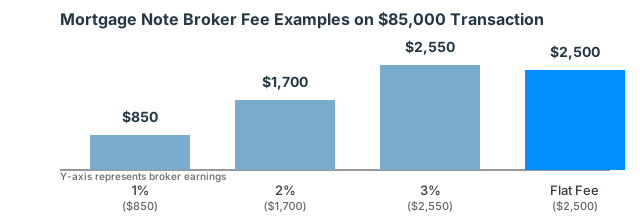
| Percentage Fee | 1.0% – 3.0% | 2.0% = $1,700 | Buyer invoice includes line item for broker fee | End of transaction via escrow disbursement |
| Flat Fee | $1,000 – $5,000+ | $2,500 flat | Buyer invoice includes line item for broker fee | End of transaction via escrow disbursement |
| Tiered Percentage | Varies by transaction size | 3% on first $50K, 2% on amount above | Calculated fee shown on invoice | End of transaction via escrow disbursement |
| Minimum Fee Structure | 2% or $1,500 minimum | Higher of $1,700 or $1,500 | Calculated fee shown on invoice | End of transaction via escrow disbursement |
Visual Comparison: Broker Fee Examples on an $85,000 Note
Factors Influencing Broker Fee Structures
Successful mortgage note brokers consider multiple factors when determining their fee structure:
- Transaction Complexity: Non-performing notes typically command higher broker fees (2-3%) vs. performing notes (1-2%)
- Deal Size: Larger transactions may justify lower percentage fees but higher absolute dollar amounts
- Market Conditions: Competitive markets may compress fees; specialized niches may support premium pricing
- Due Diligence Requirements: More extensive buyer requirements justify higher fees
- Seller Motivation: Highly motivated sellers may accept higher total transaction costs including broker fees
- Buyer Relationship: Established buyers with streamlined processes may accept standard fee structures
- Geographic Considerations: Some markets have established norms for broker compensation
Best Practice: Establish your fee structure upfront with both buyer and seller before entering negotiations. Transparency about your broker fee prevents surprises during closing and maintains trust with all parties. Many successful mortgage note brokers include fee structures in their service agreements.
Step-by-Step Process for Brokering Notes on Paperstac
Paperstac’s Core Guidance for Note Brokers:
- Tell the seller you intend to act as a broker
- After due diligence and price agreement, use the closing schedule “Escrow and Audit”
- Use your buyer’s vesting profile (the entity purchasing the note)
- Maintain all transaction activity on-platform to ensure compliance
Complete Transaction Workflow for Mortgage Note Brokers
| Phase | Your Action as Note Broker | Where in Paperstac | Key Considerations |
|---|---|---|---|
| Pre-Transaction | Align with buyer criteria, confirm investment parameters, establish fee structure | Your buyer intake process | Verify buyer has capital available, confirm buy box matches listing |
| Asset Identification | Search Paperstac for notes matching buyer criteria | Platform search/browse | Review listing details, seller notes, attached documentation |
| Seller Disclosure | Contact seller, disclose you’re acting as broker for buyer | Initial message/contact | Transparency required—seller must know you’re representing buyer |
| Preliminary Due Diligence | Review available documents, request additional information if needed | Document review section | Payment history, property details, borrower information, title status |
| Buyer Presentation | Present opportunity to buyer with your analysis and recommendation | Off-platform buyer communication | Include your due diligence findings, risk assessment, yield calculations |
| Negotiation | Facilitate price negotiation between buyer and seller, coordinate deeper due diligence | Transaction negotiation interface | Manage expectations both sides, document all agreements |
| Price Agreement | Confirm final price including your broker fee | Transaction agreement | Ensure all parties understand total transaction costs |
| Closing Schedule Selection | Choose “Escrow and Audit” closing schedule | Closing schedule dropdown | Paperstac-recommended schedule for brokered transactions |
| Vesting Profile | Enter buyer’s vesting profile (legal entity purchasing note) | Vesting profile section | Accuracy critical—this determines who appears on purchase documents |
| Broker Fee Entry | Add your broker fee (percentage or flat amount) | Broker fee section | Fee deducted from buyer’s escrow payment at disbursement |
| PSA Generation & Signing | Send Purchase Sale Agreement to buyer for signature (buyer doesn’t need Paperstac account) | Negotiation step email link | Buyer signs via email link; PSA stored on platform as backup |
| Closing To-Dos | Add buyer shipping address, servicing transfer information | Closing phase to-dos | Where collateral documents ship after close |
| Invoice & Payment | Provide buyer with invoice including your broker fee | Buyer invoice generation | Buyer sees transparent breakdown of purchase price + broker fee |
| Escrow & Closing | Monitor escrow process, coordinate any final requirements | Escrow status tracking | Funds held in escrow until all closing conditions met |
| Payout | Add PayPal details; receive broker fee payout | My Account / payout section | Broker fee disbursed via PayPal at transaction completion |
| Post-Closing | Facilitate servicing transfer, document delivery, answer questions | Post-close communication | Ensure smooth transition to buyer; maintain relationships for future deals |
Due Diligence Responsibilities for Mortgage Note Brokers
As a mortgage note broker, you play a critical role in the due diligence process. While the buyer ultimately makes the investment decision, you’re expected to coordinate and often facilitate key due diligence activities:
Document Verification
- Original promissory note or certified copy
- Mortgage or deed of trust (security instrument)
- Assignment of mortgage documentation
- Title report or title insurance policy
- Payment history (servicing records)
- Property insurance verification
- Property tax status
- Homeowner association documents (if applicable)
Financial Analysis
- Verify unpaid principal balance (UPB)
- Calculate current loan-to-value (LTV)
- Assess property value (BPO, appraisal, or AVM)
- Review payment history for consistency
- Calculate yield to maturity or expected IRR
- Model various exit scenarios
Legal and Compliance
- Verify chain of title
- Check for subordinate liens
- Review for regulatory compliance
- Identify any legal issues (bankruptcy, foreclosure proceedings)
- Confirm proper assignment documentation
Understanding Vesting Profiles for Note Brokers
The vesting profile is one of the most critical components of brokering notes on Paperstac. It identifies the legal entity that is purchasing the mortgage note—which is your buyer’s entity, not your brokerage entity.
Many new mortgage note brokers make the mistake of entering their own information in the vesting profile. This is incorrect and can create significant legal and tax complications. You are the broker facilitating the transaction; your buyer is the actual purchaser.
Required Vesting Profile Fields
| Field | Description | Example |
|---|---|---|
| Entity Name | Legal name of the purchasing entity | “ABC Investments LLC” or “John Doe IRA c/o Equity Trust Company” |
| Entity Type | LLC, Corporation, IRA, Individual, Trust, etc. | “Limited Liability Company” or “Self-Directed IRA” |
| Signer Name | Authorized individual who will sign purchase documents | “Jane Smith” |
| Signer Title | Role/title of the authorized signer | “Manager,” “President,” “Custodian,” “Trustee” |
| Phone Number | Contact number for buyer’s authorized representative | (555) 123-4567 |
| Email Address | Email for PSA delivery and transaction communications | jane.smith@abcinvestments.com |
| Street Address | Legal mailing address of purchasing entity | 123 Investment Boulevard |
| City, State, ZIP | Complete mailing address | Austin, TX 78701 |
| EIN or SSN | Tax identification number (if required) | XX-XXXXXXX (may not be required for all transactions) |
Common Vesting Scenarios for Mortgage Note Brokers
1. LLC Purchasing Entity
Entity Name: Summit Note Investments LLC
Signer: Michael Johnson, Manager
Use Case: Most common for professional note investors, provides liability protection
2. Self-Directed IRA
Entity Name: Robert Davis IRA FBO Robert Davis c/o Equity Trust Company
Signer: [Custodian Representative], Custodian
Use Case: Tax-advantaged investing, requires custodian involvement
3. Individual Investor
Entity Name: Sarah Martinez
Signer: Sarah Martinez
Use Case: Smaller investors, personal investment accounts
4. Trust
Entity Name: The Johnson Family Trust
Signer: David Johnson, Trustee
Use Case: Estate planning, wealth management
For self-directed IRA purchases, the custodian must be involved in the transaction. The vesting should reflect “IRA FBO [Individual Name] c/o [Custodian Name]” and the custodian must sign purchase documents. Mortgage note brokers must understand IRA prohibited transaction rules to avoid costly mistakes.
Vesting Profile Best Practices
- Collect Information Early: Obtain complete vesting details during your buyer intake process, before you start sourcing assets
- Verify Documentation: Request a copy of the entity formation documents (LLC operating agreement, IRA account statement, etc.) to confirm accuracy
- Double-Check Signer Authority: Ensure the person designated to sign actually has legal authority to bind the entity
- Coordinate with IRA Custodians: If buyer is using self-directed IRA, loop in custodian early—they have specific procedures and timelines
- Update for Changes: If buyer changes entities between deals, update vesting profile information accordingly
PSA Signing Process for Mortgage Note Brokers
The Purchase Sale Agreement (PSA) is the binding contract between the note seller and your buyer. Understanding the PSA signing process is essential for mortgage note brokers facilitating transactions on Paperstac.
Key Facts About PSA Signing on Paperstac
- No Paperstac Account Required: Your buyer does NOT need to create a Paperstac account to sign the PSA
- Email-Based Signing: Paperstac sends a secure email link to the buyer’s email address from the vesting profile
- Electronic Signature: Buyer signs electronically through the secure link
- Platform Backup: Signed PSA automatically appears on the platform as a backup copy
- All Parties Receive Copies: Seller, buyer, and broker all receive executed PSA copies
What to Tell Your Buyer About PSA Signing
Sample Communication to Buyer:
“Once we finalize the price and terms, Paperstac will email you a secure link to review and sign the Purchase Sale Agreement. You don’t need to create an account—simply click the link in the email, review the PSA, and sign electronically. The entire process takes just a few minutes. After you sign, you’ll receive a copy of the executed agreement, and the transaction will move forward to the closing phase where we’ll coordinate escrow and documentation.”
Common PSA Questions from Buyers
Q: Can we modify the standard PSA?
Paperstac uses standardized PSAs to streamline transactions. Significant modifications may require negotiation with the seller and could slow the transaction. Most buyers find the standard PSA acceptable, but you can discuss specific concerns with Paperstac support if needed.
Q: What happens after PSA signing?
After PSA execution, the transaction moves to the closing phase. The buyer will receive an invoice detailing the purchase price, broker fee, and any other closing costs. Funds are deposited into escrow, and upon satisfaction of all closing conditions, the note assignment documents are executed and collateral materials are shipped.
Q: Is the PSA binding?
Yes, the PSA is a legally binding contract. Both buyer and seller have obligations under the agreement. Review carefully before signing.
Q: What if my buyer is an IRA?
For self-directed IRA purchases, the custodian typically needs to review and approve the PSA before signing. Build extra time into your timeline for IRA custodian review processes.
Compliance Requirements for Mortgage Note Brokers
Mortgage note brokers must navigate an evolving regulatory landscape. While the secondary mortgage note market has different compliance requirements than origination, maintaining high ethical standards and understanding applicable regulations protects your business and clients.
Key Compliance Considerations
1. Platform Terms of Service
Paperstac has clear terms prohibiting certain behaviors that mortgage note brokers must respect:
- No Off-Platform Transactions: Once you engage on a transaction through Paperstac, complete it on-platform
- No Asset Shopping: Don’t initiate a transaction with a seller, agree on price, then shop the asset to multiple buyers off-platform
- Transparency Required: Disclose your role as a broker to all parties
- Honest Representation: Don’t misrepresent asset details, buyer qualifications, or transaction terms
Violating Paperstac’s terms can result in removal from the platform, damage to professional reputation, and potential legal liability. The note investing community is relatively small—your reputation is your most valuable asset as a mortgage note broker.
2. State Licensing Requirements
Licensing requirements for mortgage note brokers vary by state. Some states regulate secondary market note transactions, while others do not. Key considerations:
- Consult with legal counsel about licensing requirements in states where you operate
- Some states may require mortgage broker licenses even for secondary market transactions
- Real estate broker licenses may be applicable in certain jurisdictions
- Document your compliance research and maintain records
3. Disclosure Requirements
Best practices for mortgage note broker disclosures:
- To Sellers: Disclose that you’re acting as a broker representing a buyer, not purchasing for your own account
- To Buyers: Disclose your broker fee structure upfront and any other compensation you receive
- Dual Agency: If you represent both buyer and seller in the same transaction, disclose this to both parties in writing
- Conflicts of Interest: Disclose any relationships or circumstances that could create conflicts
4. Consumer Protection Considerations
The Consumer Financial Protection Bureau (CFPB) has enhanced transparency requirements for mortgage transactions. While these primarily apply to originations, mortgage note brokers should maintain similar standards:
- Provide clear documentation of all fees and costs
- Don’t make misleading representations about yield, risk, or returns
- Ensure buyers understand the nature of mortgage note investments
- Maintain accurate records of all transactions
Source: CFPB Regulatory Updates, AD Mortgage Market Review 2024
5. Anti-Money Laundering (AML) Awareness
While mortgage note brokers may not be subject to the same AML requirements as financial institutions, understanding red flags protects your business:
- Know your buyers—understand source of investment funds
- Be wary of requests for unusual payment structures
- Document buyer and seller identities
- Report suspicious activity if you have concerns
6. Tax Compliance
Mortgage note brokers must handle tax reporting properly:
- Report broker fee income on your tax returns
- Issue 1099s if you pay other service providers (appraisers, title companies, etc.)
- Maintain detailed records of all transaction-related expenses
- Consider working with tax professionals familiar with note investing
Complete Pre-Transaction Checklist for Mortgage Note Brokers
Use this comprehensive checklist before initiating each transaction to ensure you have all necessary information and have completed all required steps.
Pre-Transaction Broker Checklist
Frequently Asked Questions About Mortgage Note Brokering
Conclusion: Building a Successful Mortgage Note Brokerage Business
The mortgage note brokerage market presents substantial opportunities for professionals who understand the transaction process, maintain ethical standards, and provide value to both buyers and sellers. With the global market projected to reach $151.6 billion by 2028 and growing demand for alternative investments, skilled mortgage note brokers are well-positioned for success.
Platforms like Paperstac have democratized access to the mortgage note market, making it easier than ever to connect qualified buyers with motivated sellers. By following the processes outlined in this guide—from understanding buyer criteria and vesting profiles to managing compliance and fee structures—you can build a thriving note brokerage business.
Key Takeaways for Mortgage Note Brokers:
- The mortgage brokerage market is growing at 7.3% CAGR globally, with investor lending being the fastest-growing segment
- Technology adoption and AI-driven processes are reshaping how mortgage note brokers operate
- Transparency, compliance, and platform integrity are non-negotiable for long-term success
- Understanding buyer criteria, vesting profiles, and due diligence processes separates successful brokers from struggling ones
- Broker fees typically range from 1-3% but should reflect the value and complexity you bring to each transaction
- Building strong relationships with both buyers and sellers creates sustainable deal flow
Whether you’re new to brokering notes on Paperstac or looking to scale your existing mortgage note brokerage business, this guide provides the foundation you need to navigate transactions successfully, serve clients effectively, and build a reputation as a trusted professional in the growing mortgage note investment community.