
Ideas for a better investment
Deed of Trust vs. Mortgage: What’s the Difference?
What's the difference between a deed of trust vs mortgage? This guide explains how each works, & why it matters for note investors.

13 min read
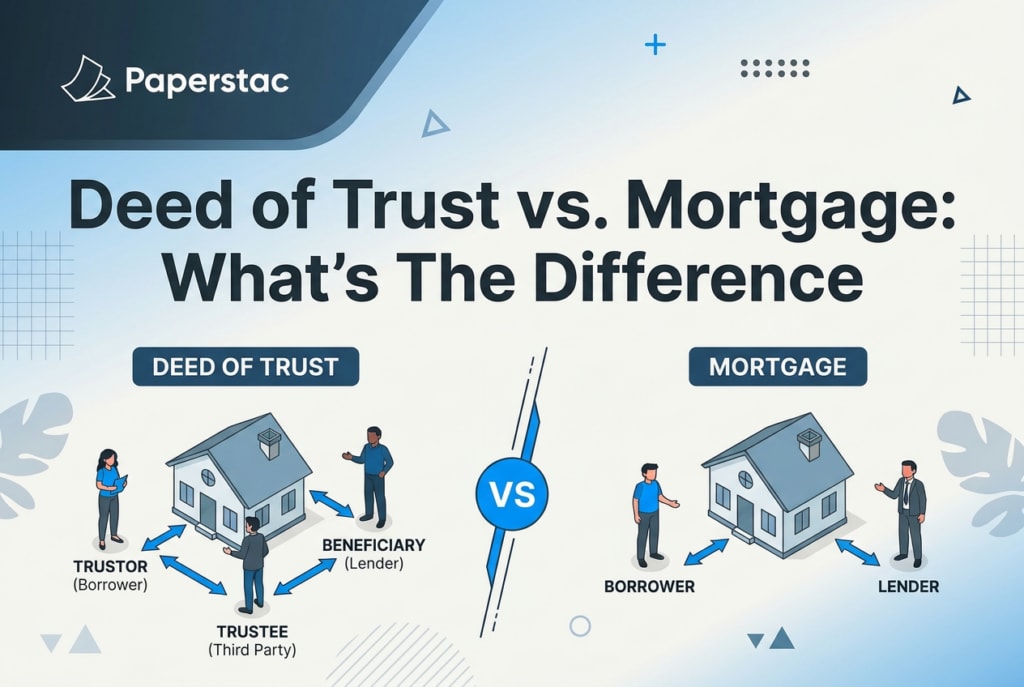
A deed of trust and a mortgage both secure a real estate loan by pledging the property as collateral — but they are not the same document, and the difference matters significantly for borrowers, sellers, and mortgage note investors alike. The key distinction between a mortgage vs deed of trust comes down to who holds the security interest, how many parties are involved, and — most importantly — how quickly a lender can recover the property if a borrower defaults. This guide breaks down exactly how each instrument works, which states use which, and what it means when you’re buying or selling a mortgage note.
Key Takeaways
- Both a mortgage and a deed of trust are security instruments that pledge real property as collateral for a loan — neither is the actual loan itself (that’s the promissory note).
- A mortgage involves two parties (borrower + lender); a deed of trust involves three (borrower + lender + trustee).
- Mortgages typically require judicial foreclosure through the courts, which can take 12–36 months. Deeds of trust usually allow non-judicial (power of sale) foreclosure, which takes 3–6 months.
- About 30 states primarily use deeds of trust; roughly 20 use mortgages. Some states permit both.
- For mortgage note investors, the state’s foreclosure process is a critical risk factor — slower judicial states mean longer resolution timelines and higher carrying costs if a borrower defaults.
- When a mortgage note is sold, the security instrument (mortgage or deed of trust) must be formally assigned and recorded alongside the note transfer.
What Is a Mortgage?
A mortgage is a legal security instrument in which a borrower (the mortgagor) pledges real property as collateral to secure a loan from a lender (the mortgagee). If the borrower defaults, the lender has the legal right to pursue foreclosure to recover the property and repay the outstanding debt.
A mortgage is a two-party agreement — only the borrower and the lender are involved. The borrower retains both legal and equitable title to the property throughout the loan term, with the mortgage serving as a lien against the property that is recorded in the public county records.
📋 Important Distinction
A mortgage is not the loan itself. The loan is documented in a separate promissory note (also called a mortgage note). The mortgage is the security instrument that ties the loan to the property. Both documents are signed at closing.
In states that use the mortgage instrument, foreclosure is almost always a judicial process — meaning the lender must file a lawsuit in court to obtain a judgment before the property can be seized and sold.
What Is a Deed of Trust?
A deed of trust (also called a trust deed) is an alternative security instrument used in many states in place of a traditional mortgage. Like a mortgage, it pledges real property as collateral for a loan. The critical difference is the structure: a deed of trust involves three parties instead of two.
- Trustor (Borrower) — the person taking the loan and conveying bare legal title to the trustee.
- Beneficiary (Lender) — the lender who funds the loan and holds the beneficial interest.
- Trustee — a neutral third party (often a title company) that holds bare legal title to the property on behalf of the lender until the loan is repaid.
- Mortgagor (Borrower) — pledges the property as collateral and retains full title throughout the loan term.
- Mortgagee (Lender) — holds a lien on the property as security for the loan. Must pursue court action to foreclose.
Because the trustee technically holds bare legal title, a lender (beneficiary) in a deed of trust state can often instruct the trustee to conduct a foreclosure sale without going through the courts — a process called non-judicial foreclosure or power of sale foreclosure.
Key Differences: Deed of Trust vs. Mortgage
While both instruments accomplish the same fundamental goal — securing a real estate loan with the property as collateral — the operational differences between them are significant, particularly when a default occurs.
| Feature | Deed of Trust | Mortgage |
|---|---|---|
| Number of Parties | Three: trustor, beneficiary, trustee | Two: mortgagor, mortgagee |
| Who Holds Title | Trustee holds bare legal title | Borrower holds full legal + equitable title |
| Foreclosure Type | Non-judicial (power of sale) in most cases | Judicial (court process) in most cases |
| Foreclosure Timeline | 3–6 months (faster) | 12–36+ months (slower) |
| Lender Cost to Foreclose | Lower — no litigation required | Higher — attorney fees, court costs |
| Borrower Redemption Rights | Limited or none post-sale in most states | Statutory redemption period in many states |
| Release Document | Reconveyance (recorded at payoff) | Satisfaction of Mortgage / Mortgage Release |
| Common States | CA, TX, VA, NC, CO, AZ, WA, OR | FL, NY, NJ, IL, OH, PA |
How Foreclosure Works Under Each Instrument
The most consequential difference between a deed of trust and a mortgage — especially for investors — is what happens when a borrower stops making payments.
Judicial Foreclosure (Mortgage States)
In states that use the mortgage instrument, lenders must file a lawsuit to foreclose. This process requires serving the borrower with legal notice, waiting for the court’s response period, obtaining a foreclosure judgment, and scheduling a sheriff’s or public sale. From first missed payment to completed sale, judicial foreclosures in states like New York, New Jersey, or Florida routinely take 18–36 months and can cost lenders tens of thousands of dollars in legal fees and carrying costs.
Non-Judicial Foreclosure (Deed of Trust States)
In deed of trust states, the trustee can conduct a power of sale foreclosure without court involvement — as long as the process follows state-mandated notice periods and procedures. The lender notifies the trustee of the default, a notice of default and notice of trustee’s sale are recorded and served, and the property is sold at a trustee’s auction. In California, for example, the process typically takes 3–4 months from notice of default to trustee’s sale.
📊 Note Investor Insight
Foreclosure timelines directly affect a note investor’s exit strategy and risk model. Buying a non-performing note in a judicial foreclosure state means potentially waiting 2–3 years and spending significant legal fees before resolving the asset. That risk is priced into the discount — NPNs in judicial states sell at steeper discounts than comparable notes in deed of trust states. Always factor the state’s foreclosure process into your due diligence.
Which States Use a Deed of Trust vs. a Mortgage?
The security instrument used in your state is determined by state law, not by the lender or borrower. Here is a general breakdown — note that some states allow both instruments and the choice may depend on lender preference.
Primarily Deed of Trust States
Primarily Mortgage States
⚠️ Important Note
Several states — including Michigan, Minnesota, and North Carolina — permit both instruments, and lender or title company preference may determine which is used. Always verify the security instrument type when reviewing a note’s documentation.
Why the Deed of Trust vs. Mortgage Distinction Matters for Note Investors
For mortgage note investors on platforms like Paperstac, understanding which security instrument backs a note is a fundamental part of due diligence — not just a legal technicality.
1. It Determines Your Foreclosure Risk and Timeline
If a performing note you purchase becomes non-performing, your ability to resolve the asset quickly depends heavily on the state’s foreclosure process. A note secured by a deed of trust in Texas can move through foreclosure in as little as 60 days after the cure period. A mortgage-secured note in New Jersey could take three years or more.
2. It Affects Note Pricing
The foreclosure environment is priced into the discount. Non-performing notes in mortgage (judicial) states sell at deeper discounts than equivalent notes in deed of trust (non-judicial) states — because buyers account for the longer recovery timeline and higher legal costs in their yield calculation.
3. It Informs Your Exit Strategy
Note investors typically pursue one of three exit strategies on non-performing notes: loan reinstatement/modification, deed in lieu of foreclosure, or foreclosure. In deed of trust states, the third option is faster and more predictable — which gives investors more strategic flexibility when evaluating a distressed note.
4. It Determines What Documents Must Transfer
When buying a note, you must receive both the promissory note (endorsed to you) and the security instrument (assigned to you via a recorded assignment). Whether that’s an Assignment of Deed of Trust or an Assignment of Mortgage depends entirely on which instrument was used at origination.
What Happens to the Security Instrument When a Mortgage Note Is Sold?
When a mortgage note is sold on the secondary market, the security instrument must be formally transferred alongside the note. The sale of the note alone — without assignment of the mortgage or deed of trust — does not give the buyer enforceable security interest in the collateral property.
- Promissory Note Transfer: The seller endorses the note to the buyer, typically via an allonge (a page attached to the note for endorsements), or via a blank endorsement making it a bearer instrument.
- Mortgage Assignment: In mortgage states, the seller executes an Assignment of Mortgage, which is recorded with the county recorder where the property is located.
- Deed of Trust Assignment: In deed of trust states, the seller (beneficiary) executes an Assignment of Deed of Trust, which is similarly recorded in the county property records.
- Borrower Notification: Under federal RESPA law, the borrower must be notified in writing within 15 days of the loan’s transfer — regardless of whether it’s secured by a mortgage or deed of trust.
💡 Due Diligence Tip
When purchasing a note, always request a chain of title search on the security instrument to confirm there are no gaps in assignment history. A missing assignment in the chain can create significant legal complications — and in some states, may impair the ability to foreclose.
Key Terms Glossary
These are the core terms you’ll encounter when working with mortgage notes secured by either a mortgage or a deed of trust.
- Promissory Note (Mortgage Note)
- The borrower’s written promise to repay a loan, including the interest rate, payment schedule, and default provisions. The note is the actual debt instrument; the mortgage or deed of trust is the security instrument that ties it to real property.
- Mortgage
- A two-party security instrument pledging real property as collateral for a loan. The borrower (mortgagor) grants the lender (mortgagee) a lien on the property, which is enforced through judicial foreclosure if the borrower defaults.
- Deed of Trust
- A three-party security instrument in which the borrower (trustor) conveys bare legal title to a trustee to hold on behalf of the lender (beneficiary). Allows non-judicial foreclosure via power of sale in most states, making it a faster foreclosure instrument than a mortgage.
- Trustee
- The neutral third party in a deed of trust who holds bare legal title to the property. The trustee has no beneficial interest in the property and acts only as directed — either to reconvey title when the loan is repaid or to conduct a trustee’s sale if the borrower defaults.
- Judicial Foreclosure
- A foreclosure process that requires the lender to file a lawsuit in court and obtain a judicial judgment before the property can be sold. Common in mortgage states. Typically takes 12–36 months and involves attorney fees and court costs.
- Non-Judicial Foreclosure (Power of Sale)
- A foreclosure process conducted by the trustee without court involvement, following state-mandated notice and waiting periods. Common in deed of trust states. Typically takes 3–6 months, significantly reducing lender costs and investor risk exposure.
- Reconveyance
- The document issued by a trustee that releases a deed of trust from a property’s title when the underlying loan is fully repaid. Recorded in county records to clear the lien. The mortgage equivalent is called a Satisfaction of Mortgage or Mortgage Release.
- Assignment of Mortgage / Assignment of Deed of Trust
- The legal document that transfers the security instrument from one party (the seller/original lender) to another (the buyer/new lender) when a note is sold. Must be recorded in the county where the property is located to protect the buyer’s security interest.
- Chain of Title
- The complete sequential history of all recorded ownership interests, liens, and assignments for a property or security instrument. A broken chain — caused by missing or unrecorded assignments — can create legal complications for note buyers seeking to enforce their security interest.
Frequently Asked Questions
Common questions about deeds of trust, mortgages, and what the difference means for real estate and note investing.
What is the main difference between a deed of trust and a mortgage?
Which states use a deed of trust instead of a mortgage?
Can a mortgage note be secured by a deed of trust?
Why does the foreclosure process matter to mortgage note investors?
What happens to the deed of trust when a mortgage note is sold?
Is a deed of trust the same as a property deed?
Does a deed of trust show up on a credit report?
What is a reconveyance in a deed of trust?
Buy & Sell Mortgage Notes Online
Paperstac is the marketplace where note investors, sellers, and lenders connect to transact — transparently, efficiently, and on their own terms.
Explore the Marketplace →Keep Learning
Sources & References
- Consumer Financial Protection Bureau. What is a deed of trust? consumerfinance.gov (2025).
- Cornell Law School Legal Information Institute. Deed of Trust. law.cornell.edu.
- Mortgage Bankers Association. Foreclosure Timeline Data by State. mba.org (2025).
- U.S. Department of Housing and Urban Development. Real Estate Settlement Procedures Act (RESPA). hud.gov.
© 2026 Paperstac. All rights reserved. This content is for informational purposes only and does not constitute legal, financial, or investment advice. Consult a qualified professional before making real estate or investment decisions.

📄 Download Our FREE Intro to Note Investing Guides 👇
Get a taste of the exciting world of note investing with our FREE intro guides.
