
Ideas for a better investment
Definitive Guide to Note Investing
The Definitive Guide to Note Investing can help you build passive income, diversify your portfolio, and master the world of debt investing.

19 min read
The Definitive Guide to Note Investing can help you build passive income, diversify your portfolio, and master the world of real estate debt investing.
Mortgage note investing is one of the most powerful ways to generate relatively passive income with real estate. This definitive guide to note investing will help you understand everything from — what a mortgage note is, to how to evaluate and buy them, exit strategies, and resources to scale your note business.
Key Takeaways
- A mortgage note is the legal promissory note where a borrower agrees to repay a loan; the mortgage (or deed of trust) is the separate document that secures that promise with the property.
- Investors buy notes — not properties — for largely passive income, portfolio diversification, and multiple exit strategies, often at a discount to the unpaid principal balance.
- Performing notes (borrower current on payments) typically trade at or near par and suit investors who want steady, lower-effort cash flow.
- Non-performing notes (90+ days delinquent) trade at steeper discounts and require active management, but offer more room for upside through loan modification, resale, or foreclosure.
- Due diligence — reviewing the collateral file, payment history, title, and property condition — is the single biggest factor separating profitable note deals from costly ones.
- Notes can be purchased with cash, joint ventures, or tax-advantaged accounts like a Self-Directed IRA, and platforms like Paperstac make sourcing and closing deals more transparent.
1What Is a Mortgage Note?
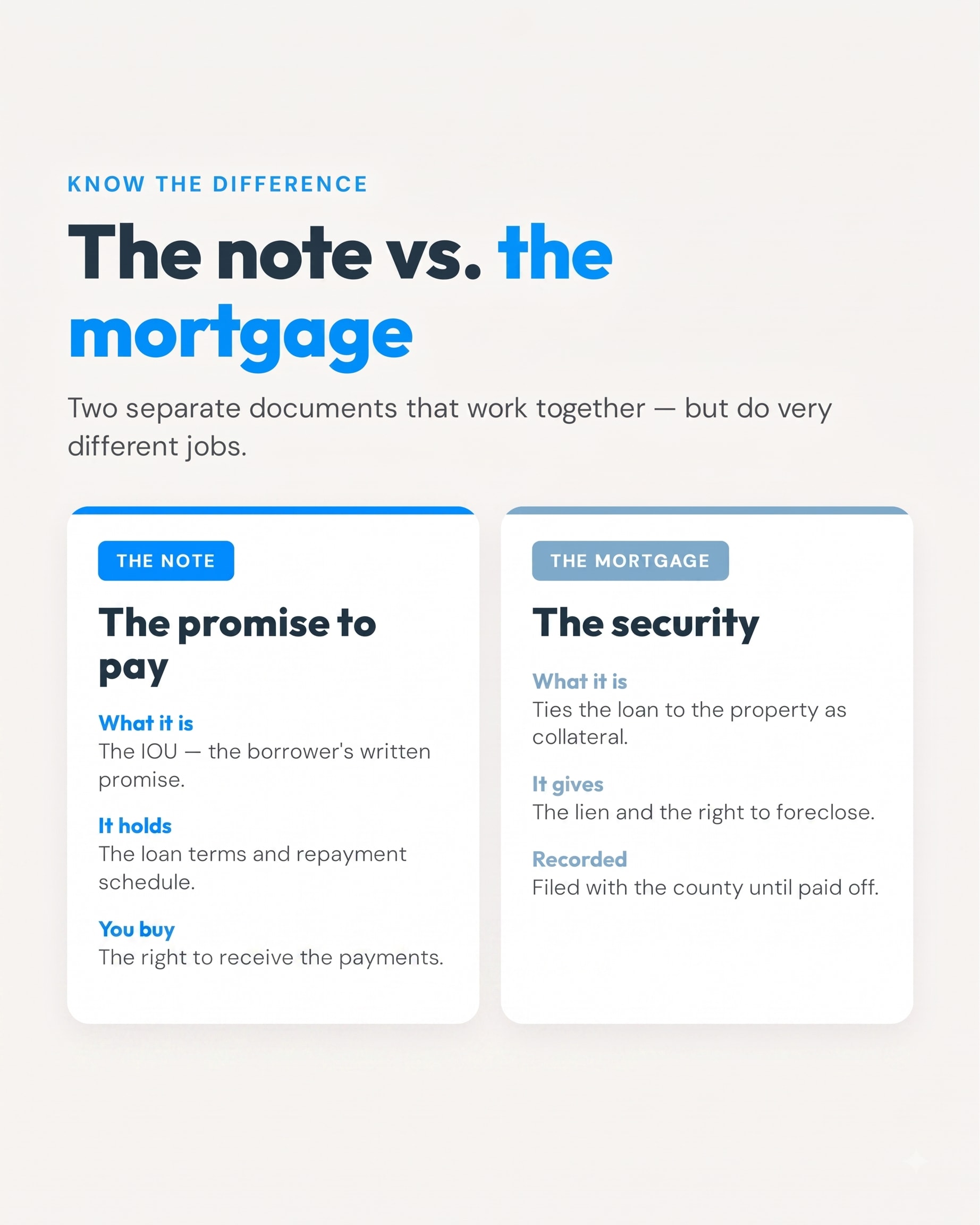
A mortgage note is a legal contract that outlines the loan terms between a borrower and a lender. It acts as a written promise to repay a loan secured by real estate. Think of it as an IOU.

Mortgage vs. Note: What’s the Difference?
What is the difference between a mortgage and a note?
1. Mortgage (or Deed of Trust)
- What it is: A legal document that secures the loan using the property as collateral.
- Purpose: Protects the lender — if the borrower defaults, the lender can foreclose. It secures the loan by using the property as collateral.
- Who holds it: Typically recorded with the county and remains in place until the loan is paid off.
2. Mortgage Note (or Promissory Note)
- What it is: A written promise from the borrower to repay the loan under specific terms (interest rate, payment schedule, etc.).
- Purpose: Acts as the IOU — the actual contract between borrower and lender for repayment.
- Who holds it: Initially held by the lender, but it can be bought and sold to other investors.
Summary:
- The mortgage note is the loan agreement.
- The mortgage is the security instrument that makes the home collateral for that loan.
You can’t have a mortgage without a mortgage note, but you can sell or transfer the mortgage note (as investors do) without changing who holds the mortgage lien — which is why note investing exists.
Anatomy of a Mortgage Note
- Loan Amount: The original borrowed amount.
- Interest Rate: Fixed or adjustable.
- Loan Term: Typically 15 or 30 years.
- Payment Schedule: Monthly, quarterly, or balloon payments.
- Default Clauses: Penalties and foreclosure provisions.

How To Obtain a Copy of Your Mortgage Note
It’s also important to note: when purchasing a mortgage loan, always try to obtain the original promissory note. In some cases, the original may have been lost or destroyed, and a lost note affidavit is provided instead. While this is generally acceptable if a copy of the note exists, it’s best to secure the original “wet ink” note whenever possible, as it serves as the primary proof of loan ownership. Think of it like a check — who’s entitled to the money if it’s not endorsed? Typically, whoever holds the check.
If you need to request a copy of the mortgage note, you can reach out to:
- Your lender
- The registry of deeds
- The county recorder’s office
- Your mortgage broker (if applicable)
Types of Mortgage Notes
- Loan Type: Secured, Unsecured, Institutional, Private
- Lien Position: First lien, Second lien
- Asset Class: Residential, Commercial, Land

Performing vs. Non-Performing Notes
Both performing and non-performing mortgage notes offer unique benefits, depending on your investment goals, risk tolerance, and level of involvement.
Performing Notes
In mortgage note investing, understanding the distinction between performing and non-performing notes is key. A performing note is one where the borrower is consistently making their payments on time, as agreed upon in the loan terms. These notes are typically considered lower risk and are attractive to investors seeking steady, largely passive income streams. Since the loan is current, investors can expect regular cash flow with less need for intervention or loan workout strategies. Performing notes usually trade at a premium due to their reliability and reduced management requirements.
Non-Performing Notes
On the other hand, a non-performing note is a loan where the borrower has fallen behind on payments — usually by 90 days or more. These notes carry higher risk and require active management, but they can also be purchased at a steep discount. Investors in non-performing notes may use strategies like loan modification, foreclosure, or deed-in-lieu to resolve the situation and recover value. While non-performing notes require more due diligence and hands-on work than performing notes, they can be profitable for experienced investors who know how to navigate borrower negotiations and asset recovery.
| Factor | Performing Note | Non-Performing Note |
|---|---|---|
| Payment status | Current (under 30 days late) | Delinquent (90+ days late) |
| Typical pricing | At or near par, sometimes a slight premium | Steep discount to unpaid principal balance |
| Risk level | Lower | Higher |
| Investor involvement | Largely passive — collect payments via a servicer | Active — modification, foreclosure, or resale required |
| Best suited for | Investors who want predictable cash flow | Experienced investors comfortable with workouts |
Both types of mortgage notes can be profitable investment vehicles, and many experienced investors use a combination of both to balance cash flow and long-term growth.
2Why Invest in Mortgage Notes?
With average 30-year mortgage rates hovering near 6.55% as of mid-July 2026 (Freddie Mac’s Primary Mortgage Market Survey), fewer homeowners are refinancing or selling, which keeps the pool of existing notes — and the yields they carry for the investors who hold them — attractive for the long haul.
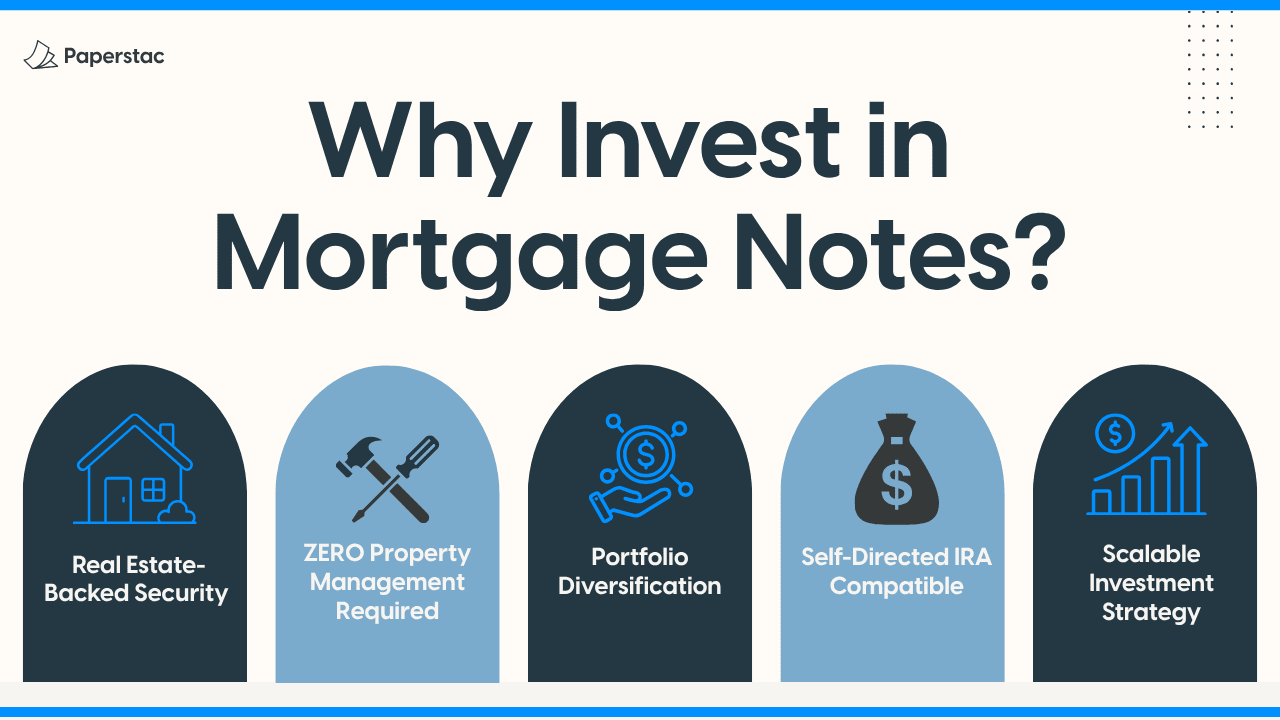
Key Benefits
- Relatively Passive Income
- Secured by Real Estate
- Portfolio Diversification
- Multiple Exit Strategies
- Tax Advantages through SDIRAs
7 Advantages of Note Investing
Why Invest in Non-Performing Notes
Investing in non-performing notes (NPNs) can be a compelling strategy for investors seeking high potential returns and the opportunity to add value through creative problem-solving. Since these loans are delinquent, they’re often sold at steep discounts — sometimes for as little as 30–60% of the unpaid balance. This discounted pricing allows investors to step into a position of equity, where they can profit from re-performing the loan, modifying terms, or taking control of the underlying property. The goal is to turn a distressed situation into a win-win outcome for both the borrower and the investor. Non-performing note investing is active, not passive — it takes capital, patience, and a plan for resolution before any return materializes.
In addition to attractive pricing, non-performing notes offer a level of control and flexibility not often found in traditional investments. Investors can choose how to approach the borrower — whether through loan workouts, short sales, or legal action like foreclosure — depending on the situation and exit strategy. With the right due diligence and loan servicing support, NPNs can deliver strong returns and portfolio diversification, especially in markets where real estate is appreciating or foreclosure alternatives are viable. They’re best suited for active investors who are comfortable navigating risk and complexity in exchange for potentially higher upside.

Why Invest in Performing Notes
Investing in performing notes is an ideal strategy for investors seeking steady, predictable income with lower risk. These notes represent loans where the borrower is current on their payments, providing consistent monthly cash flow without the need for active management or complex workout strategies. For passive investors, performing notes offer the benefit of earning interest income without the responsibility of property ownership or tenant management. They are often backed by real estate, adding an extra layer of security and collateral to the investment. Depending on loan-to-value, seasoning, and the spread between the purchase price and the note’s interest rate, performing notes typically yield somewhere in the 8–14% range annually — though every deal is different, and returns are never guaranteed.
Performing notes are especially attractive for retirement accounts like Self-Directed IRAs or Solo 401(k)s, as they deliver reliable returns over time and align well with long-term wealth-building strategies. While the upside potential might not be as high as non-performing notes, the trade-off is stability and less involvement. Investors can also mitigate risk further by carefully vetting the borrower’s payment history, the property’s value, and the loan terms. For those looking for passive income backed by real estate but without the headaches of managing properties or distressed assets, performing notes offer a smart, straightforward path.

Risk Factors in Note Investing & How to Mitigate
- Borrower Default: Review payment history, borrower behavior, and servicing notes.
- Unpaid Property Taxes: Verify taxes are up to date.
- Property Damage: Order a Broker Price Opinion (BPO).
Borrower default risk is not hypothetical. The national mortgage delinquency rate reached 4.44% in the first quarter of 2026 — up 18 basis points from the previous quarter and 40 basis points year-over-year — according to the Mortgage Bankers Association’s National Delinquency Survey (2026). That’s exactly the kind of shift due diligence is built to catch, and price for, before you buy a note.
Risk Mitigation in Mortgage Note Investing
To effectively mitigate these and other risks, thorough due diligence is essential. This means evaluating the borrower’s payment track record, examining the collateral file for completeness, confirming the property’s value through a BPO or appraisal, and verifying title status and lien position. Partnering with a licensed loan servicer helps ensure regulatory compliance and proper borrower communication throughout the life of the loan.
Further protection comes from diversifying your portfolio across multiple notes, asset types, and geographic markets. Investors should also develop clear exit strategies, stay up to date on state-specific legal processes, and seek guidance from seasoned professionals such as attorneys, servicers, and mentors. These proactive steps can significantly reduce risk and increase the chances of a profitable, hassle-free investment.
Note Investing vs. Rental Properties
What Is the Main Difference Between Note Investing and Rental Properties? At its core, rental investing means owning physical real estate and collecting rent from tenants. Mortgage note investing means owning the borrower’s debt and collecting loan payments secured by that same property. This fundamental shift from equity to debt completely transforms your workload, tax strategy, risk profile, and exit options.

3Getting Started with Note Investing
Defining Your Strategy
- Want passive income? Choose performing notes.
- Comfortable with risk? Consider non-performing notes.
- Limited time? Stick with hands-off strategies.
Sourcing Investment Capital
- Self-Directed IRA (SDIRA) — 2026 annual IRA contribution limits are $7,500 ($8,600 if you’re 50 or older), per IRS guidelines, though a SDIRA’s investing power isn’t limited to new contributions since you can also roll over existing retirement funds.
- Personal Savings
- Joint Ventures
- Private Lenders or Crowdfunding
Choosing the Right Notes
- Prioritize first lien notes
- Review borrower payment history
- Verify tax status and collateral condition
4Where to Buy Mortgage Notes
Mortgage notes can be sourced through a variety of channels, each offering unique opportunities and considerations. Whether you’re a first-time buyer or an experienced investor, knowing where to find quality notes is crucial to building a strong portfolio.
From online platforms that streamline transactions to direct relationships with hedge funds, banks, or brokers, your buying strategy can significantly influence deal flow, pricing, and risk exposure. Building relationships in the note space — both online and offline — can also open the door to off-market deals and exclusive opportunities not publicly listed.
- Online Trading Platforms (e.g., Paperstac, Notes Direct, Garnaco)
- Hedge Funds & Institutional Sellers
- Community Banks & Credit Unions
- Note Brokers & Private Sellers
- Networking & Industry Events, Meetups, and Conferences (NoteExpo, DME)
- Loan Servicing Companies
- Bankruptcy Attorneys
- Title Companies
- Note funds

5How to Evaluate a Mortgage Note (Due Diligence)
Key Documents
- Payment History
- Servicing Notes
- Collateral File (Note, Mortgage/Deed, Title Policy)
Note Investing Due Diligence Checklist
1. Asset Review
- Confirm note type: Performing, non-performing, or re-performing
- Verify loan position: 1st lien or 2nd lien
- Identify property address and property type (SFR, condo, land, etc.)
- Compare purchase price vs. unpaid principal balance (UPB)
- Check loan origination date and original loan term
- Review current unpaid principal balance (UPB) and payoff amount
- Note the interest rate and payment terms
- Determine the remaining term and loan maturity date
- Record the loan servicer information
2. Collateral File Review
- Review promissory note, mortgage or deed of trust, assignments, and allonges
- Check for chain of title continuity
- Verify endorsements are correct and complete
- Confirm the mortgage is recorded with the proper county
3. Property Information
- Gather comps: Use recent sales (3–6 months) and current listings
- Use tools: Zillow, Redfin, Realtor, Trulia, PropStream, Narrpr (licensed only)
- Focus on value range (ARV and As-Is), not fixed price
- Assume interior condition reflects exterior if unknown
- Use ProxyPics for drive-by photos to assess emotional equity
- Order a BPO (Broker Price Opinion) after indicative bid is accepted
- Tip: Let the seller know you’re spending on due diligence and that other offers may come in before the PSA is signed
4. Payment & Servicing History
- Request and review payment history (12–24 months ideally)
- Examine servicing notes for borrower contact, hardship, or payment promises
- Check for escrow account and tax/insurance payments
5. Borrower & Loan Performance
- Evaluate borrower payment trends
- Check for any modifications, forbearance, or bankruptcy history
- Note any legal actions or foreclosure activity
6. Legal & Compliance
- Ensure compliance with state-specific licensing (especially for seller-financed notes)
- Check if the loan is subject to Dodd-Frank or CFPB regulations
- Run title search and verify no senior liens exist
7. Exit Strategy Evaluation
- Define your exit strategy: Hold, mod, foreclose, resell, etc.
- Estimate costs to execute your plan (legal, rehab, foreclosure fees)
- Calculate projected ROI and timeline
8. Taxes & Insurance
- Confirm property taxes are current
- Verify there is active homeowner’s insurance (or force-placed coverage option)
- Research local property tax liens or municipal fines
9. Document Checklist
- Collateral file
- Servicing notes
- Payment history
- Property report or BPO
- Title report
- Insurance verification
- Tax certificate
10. Final Review & Offer Price
- Recalculate your bid price based on updated risk factors
- Use a pricing calculator or tool
- Submit bid with purchase and sale agreement (PSA)
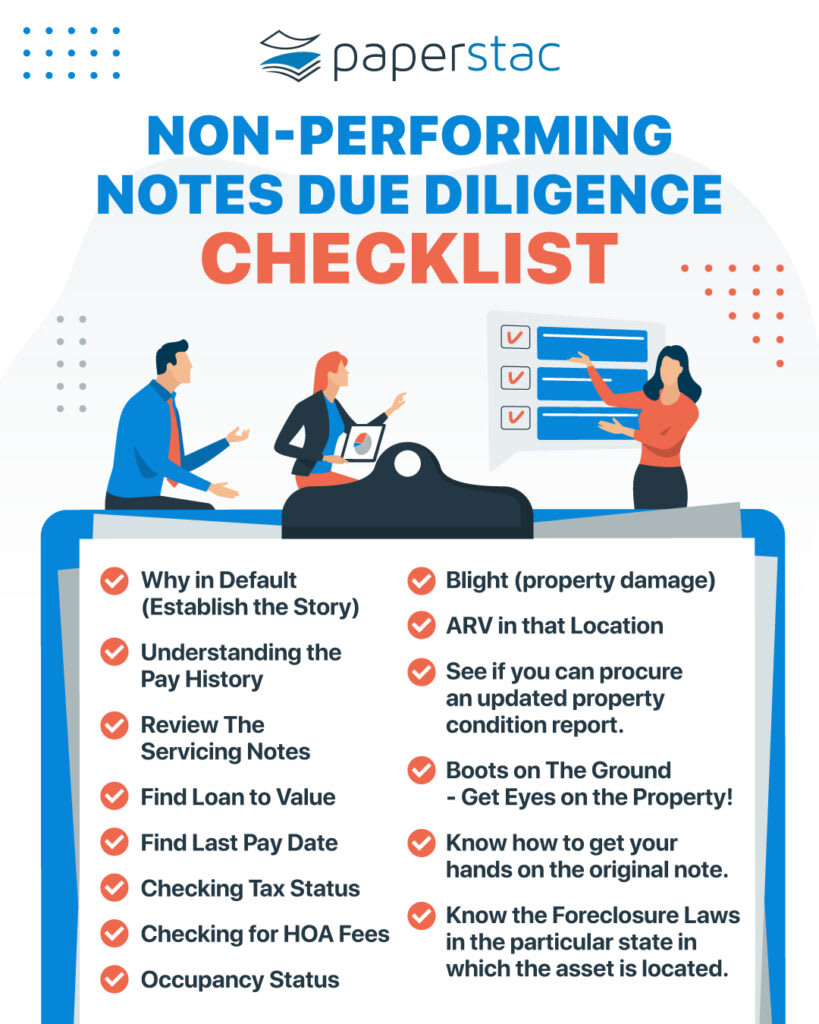
Red Flags
- Missing documents (especially original note)
- High Loan-to-Value (LTV)
- Unpaid property taxes
- Vacant/blighted property
6Exit Strategies in Note Investing
Performing Notes
- Hold for cash flow
- Sell the note to another investor
- Creating a partial
Non-Performing Notes
Examples of exit strategies for non-performing notes.
- Loan Modification
- Deed-in-Lieu of Foreclosure
- Foreclosure and REO resale
Read the full article on nine exit strategies for non-performing notes on the Paperstac blog.
7Loan Servicing & Legal Considerations
Role of a Servicer
- Collect payments
- Manage escrow
- Communicate with borrowers
Loan Servicing Guide for Note Investors by Jess Gold. Read the full guide on loan servicing for note investors on the Paperstac blog.
Legal Support
- Foreclosure assistance in judicial states
- Bankruptcy and compliance help
8Advanced Strategies to Scale Your Note Business
- Flipping Notes: Rehab and resell performing assets
- Seller Financing: Create notes from real estate you sell
- Diversify: Across lien position, geography, and asset class
- Leverage Technology: Use platforms like Paperstac to source, evaluate, and close deals faster with built-in document generation and secure transactions
9Tools & Resources for Note Investors
- Paperstac Academy – Over 16 hours of expert training
- Paperstac Marketplace – Secure online note transactions
- Facebook Groups, BiggerPockets, Paperstac Podcast
Note Investing Educational Platforms, Courses & Mentorship
- Paperstac Academy – academy.paperstac.com
- NoteSchool with Eddie Speed – noteschool.com
- Fred & Tracy Rewey – Note Investing Tools – noteinvestingtools.com
- Kevin Shortle – Education and training
- Jamie Bateman – Mentorship and coaching, Fund Manager, Investor
- Dan Deppen – Note investor, educator, and host of Fusion Notes and the Note Investor Podcast
- JKP Holdings – Note investing education & training
- Paige Panzarello – Real estate investor for over 20 years (training here)
Facebook Groups for Note Investors
Join these communities to learn, ask questions, and connect with other investors:
- Buying and Selling Mortgage Notes
- Paperstac Private Group
- (Formerly) Notes & Bolts Podcast – (Now) The Paper Trail: Note Investing Community
- Note Buyers and Sellers Club
- Real Estate Note Buyers And Sellers
- Nation Wide Note Buyers
- Seller Financed Note Buyers and Sellers Nationwide
- “Be the Bank” Real Estate Note Investing
- Note Investors Network
- The Land Sharks
Podcasts for Note Investors
- Paperstac Podcast (Mortgage Note Investing Weekly) — also on the Paperstac YouTube Channel. Hosts: Rick Allen & Brett Burky
- The Note Investor Podcast — Host: Dan Deppen
- Real Estate Notes Show (JKP Holdings)
- NoteSchool / Note Investing Podcast (Eddie Speed)
- The Paper Trail (7e Investments – Chris Seveney)
- Real Estate Without Renters (Kevin Shortle)
- Naked Notes (Jasmine & Shelby)
Note Investing Books
- Invest in Debt – Jimmy Napier
- Note Investing Made Easier – Martin Saenz
- Who Needs the Bank… – Bob Zachmeier
- Notes to Notes – Nomi Yah
- Paper Profits – Josh Andrews
- The Power of Paper – Troy Fullwood
- Win-Win Revolution – Bill Bymel
Note Investing Software & Tools
- ProTitle, Netronline (Title and Tax records)
- 10bii and Amortization Calculators
- PropStream, PropertyRadar, BatchLeads (Skip tracing & lead gen)
- BankProspector (Lender note prospecting)
Note Servicing & Tracking Software
- Moneylender Professional
- The Mortgage Office
- NoteDashboard
- NoteSmith
- Your Land Loans
- ZimpleMoney
BPO & Title Report Companies
- a360inc Title Solutions
- Accurate Group LLC
- Baldwin Advisory Group (BAG)
- EZ Title & Escrow
- First American Title
- ProTitle USA
- Title Clearing & Escrow, LLC
Legal Services for Note Investors
- Caballero Lender Services
- Carlisle Law
- Erin Quinn
- Geraci Law Firm
- Jeff Watson
- Kelly Kronenberg Attorneys at Law
- KKOS Lawyers (Kyler, Kohler, Ostermiller & Sorensen)
- Legal Foreclosure Network
- Matt Kelley
- Note Counsel (Paul & Adam Vincent)
- Scheer Law Group
- Singer Law Group
- T. Alan Ceshker, Ceshker Group
- Tarokh Law, PLLC (FL & SC)
- Tony Sottile
- Wood & Lamping LLP
Accountants & Tax Advisors
- Anderson Tax Advisors
- John Hyre, Tax Attorney
- Measured Results CPAs
- Spiegel Accountancy
- The Real Estate CPA
- Larry Pendleton
Conferences for Note Investors
Stay ahead of industry trends and grow your network by attending these events:
- Diversified Mortgage Expo (DME) – Nashville, TN
- Note Expo – Annual event by NoteSchool
- NoteWorthy Investor Summit
- IMN Conference Series – NPL Notes & Default Servicing Forum
- Cash Flow Expo – Online
- American Lending Conference – Fort Lauderdale, FL
- Women’s Private Equity Summit – Phoenix, AZ
- DDC Global Investor Summit – London, UK
- National Private Lenders Conference – Miami Beach, FL
- Distressed Forum for Bank Special Assets (East & West)
- USFN Industry Forum – Phoenix, AZ
- Real Estate Family Office & Private Wealth Forum (West) – Dana Point, CA
- Quest Expo – Irving, TX
- ADISA’s Alts Research & Due Diligence Forum – Boston, MA
- Institutional Investor Conference – Washington, DC
- AAPL’s Annual Conference
- Paper Trail – New Upcoming Conference
Note Servicing Companies
Examples of a few note servicers:
- Madison Management – loanboarding@madisonmanagement.com
- FCI Servicing – customerservice@trustfci.com
- Fay Servicing LLC – pdubas@fayservicing.com
- Note Servicing Center – stacy@noteservicingcenter.com
- SNSC – servicetransfers@snsc.com
- Evergreen Note Servicing – mail@notecollection.com
- Allied Servicing – melissa@allservicing.com
- National Asset Mortgage – info@naamortgage.com
- August REI, LLC – See contact/fees page
- Land Home Financial Services – Contact via website
- SecureNet Loan Services – info@securenetloanservices.com
Self-Directed IRA Companies
- CamaPlan
- Directed IRA Trust Company
- Entrust Administration
- Equity Trust Company
- Forge Trust (formerly IRA Services Trust)
- Inspira Financial (formerly Quest Trust Company)
- Kingdom Trust
- Mainstar Trust
- MidAtlantic IRA
- New Direction Trust Company
- NuView Trust
- uDirect IRA Services LLC
10Frequently Asked Questions
What is the minimum amount needed to invest in mortgage notes?
There’s no single minimum — note prices range from a few thousand dollars for small-balance or land notes to six figures for larger performing assets. Many new investors start with a single performing note in the $10,000–$50,000 range, or partner with other investors through a joint venture or note fund to spread capital across multiple deals.
Is mortgage note investing legal and regulated?
Yes. Note investing is a legal, established asset class, but it is subject to state licensing rules and federal regulations such as Dodd-Frank and CFPB requirements — particularly for seller-financed notes and loans involving owner-occupied residential borrowers. Always confirm state-specific requirements and work with a licensed servicer to stay compliant.
How much can I earn investing in mortgage notes?
Performing notes typically yield around 8–14% annually, depending on loan-to-value, seasoning, and the spread between purchase price and interest rate. Non-performing notes can offer higher potential returns since they’re purchased at a steep discount, but they require active management and carry more risk — returns are never guaranteed for either type.
Can I buy mortgage notes with retirement funds?
Yes. A Self-Directed IRA (SDIRA) or Solo 401(k) lets you invest retirement funds directly in mortgage notes, and any income generated typically grows tax-deferred or tax-free depending on the account type. 2026 IRA contribution limits are $7,500 annually ($8,600 for those 50 and older), though rollovers from existing retirement accounts aren’t subject to that cap.
What’s the difference between buying a note and being a hard money lender?
When you buy a note, you’re purchasing an existing loan and stepping into the lender’s position — you inherit whatever terms, payment history, and risk already exist. Hard money lending means originating a brand-new loan yourself, which gives you control over the terms from day one but requires more underwriting work upfront.
What happens if a borrower stops paying on a note I own?
Your loan servicer will attempt to contact the borrower and pursue collection under the loan terms and state law. Depending on the situation, resolution options include a loan modification, forbearance plan, deed-in-lieu of foreclosure, short sale, or foreclosure. Your original due diligence and exit strategy planning determine how quickly and profitably you can resolve a default.
Where can I safely buy and sell mortgage notes online?
Paperstac is a dedicated online marketplace built specifically for buying and selling mortgage notes, with secure transaction tools, document generation, and a transparent bidding process. Investors can also source notes through hedge funds, community banks, note brokers, loan servicers, and industry events like NoteExpo and DME.
Final Thoughts
Mortgage note investing is a scalable way to generate passive income and build wealth. With platforms like Paperstac, you can get started easily, whether you’re looking to buy your first performing note or scale a portfolio.
Ready to Take the First Step?
Join 18,000+ investors already using Paperstac to buy and sell mortgage notes.
Explore Paperstac Academy Browse Mortgage Notes Join FreePaperstac Academy — Note Investing Education
For a deeper understanding of note investing, visit Paperstac Academy for educational resources tailored for beginners. Monthly subscription now available.

Learn More with Paperstac
At Paperstac, we’re dedicated to making real estate transactions seamless and secure. Visit our blog for more real estate insights and learn how to leverage innovative tools to manage note transactions effortlessly.
For more about us, visit paperstac.com/about.
Thank you for reading! We hope you enjoyed this article from the Paperstac Blog. Reach out to jessica@paperstac.com with any mortgage note industry topics or collaboration inquiries you’d like us to cover.
Download Free Note Investing Guides

Get a taste of the exciting world of note investing with our free intro guides: marketing.paperstac.com/guides