Ideas for a better investment
How to Fund Your Mortgage Note Investments: Creative Financing Strategies
Discover innovative methods to fund your mortgage note purchases, from using personal capital and selling note partials to joint ventures.

7 min read

Investing in mortgage notes is an exciting venture that can generate substantial returns. However, one common challenge many buyers face is funding their note purchases effectively. In this article, we’ll explore various creative and practical ways to fund your mortgage note deals, from using your own capital to leveraging joint ventures, structured funds, owner financing, and more.

Starting Point: Using Your Own Capital
When you first get into mortgage note investing, the most straightforward method to fund your purchases is by using your own capital. This could be cash savings, retirement funds like a 401(k), or other personal resources. While this is the simplest and most direct approach, it often only takes you so far. Once you buy your first note or two, you’ll likely find yourself eager to acquire more notes—but your cash might not stretch as far as you want it to.
This naturally leads to exploring alternative ways to raise capital and grow your note portfolio.
Selling Note Partials for Capital
One popular strategy to recapitalize your funding account is selling note partials. But what exactly is a partial?
What Is a Note Partial?
A note partial is when a note holder sells a portion of the future payments on a loan—rather than selling the entire note. It’s a flexible strategy that allows the seller to receive a lump sum of capital upfront, while retaining ownership of the remaining payments after the partial term ends.
Partial Note Example:
If you buy a note for $35,000 with a principal balance of $55,000, you might sell a portion of the future payments for $34,000, leaving $1,000 of your own capital in the deal. The payments corresponding to the sold partial go to the buyer, and after the sold payments have been made, the note reverts fully back to you.
This method is highly effective for freeing up capital to buy more notes and is widely taught in note investing education, including Note School and the Perfecting Partials Master Class. A well-known example is Eddie Speed’s “Hundred Dollar Model,” where $100 is left in the deal to satisfy IRS requirements for a substantial investment.
Why sell a Partial?
Benefits for Note Sellers:
- Immediate Cash Flow: Receive a lump sum by selling part of your note’s future payments—without giving up the entire investment.
- Retain Long-Term Value: After the partial term ends, remaining payments revert back to you, preserving future income.
- Flexible Liquidity: Sell only the number of payments you choose, allowing you to raise capital while keeping control of the note.
- No Need for New Notes: Tap into existing notes for cash, without originating new deals or relying on new borrowers.
Why Buy a Partial?
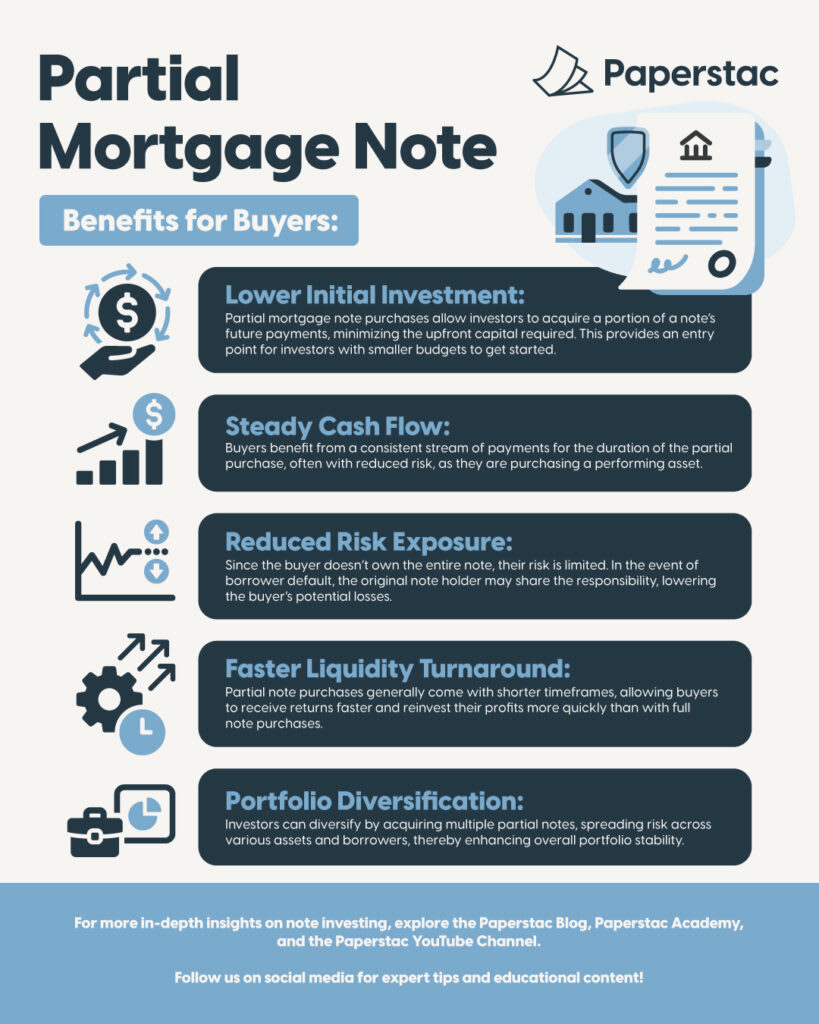
Benefits for Investors:
- Lower Investment Barrier: Buying part of a note typically requires less capital than a full note purchase.
- Predictable Returns: You know exactly how many payments you’ll receive, making it easier to forecast ROI.
- Reduced Risk Exposure: Since you’re not buying the full note, your risk is limited to the partial term.
- Quicker Liquidity Cycle: Shorter investment periods mean you can recycle capital and compound returns faster.
- Diversification: Spread your capital across multiple partials to reduce risk and increase portfolio stability.
Partnering with Joint Venture Investors
If you have a solid track record and expertise in note investing but are tapped out on capital, teaming up with a joint venture (JV) partner can be a great option. In this setup, the JV partner provides the capital while you manage the deals and operations. This arrangement benefits both parties and can allow you to scale your investments faster without selling partials.
It’s important to establish clear expectations with JV partners upfront. Determine if they will be active investors seeking frequent updates or more passive, patient capital providers. Patient capital is especially valuable in note investing where deals can take time to mature. Poor communication or mismatched expectations can lead to tension, so choose your partners carefully.
Structured Funds: Reg D and Regulation A+
For more advanced investors, structuring a mortgage note fund can be a way to raise significant capital from outside investors. A Regulation D (Reg D) fund allows you to pool money from accredited investors to purchase notes. This approach requires legal counsel, a strong track record, and a detailed business plan. While it involves upfront costs and regulatory compliance, it can enable you to raise millions to fund your note purchases.
Another option is a Regulation A+ fund, which lets you raise money from both accredited and non-accredited investors. However, this method is more expensive to set up, has fundraising caps, and requires significant ongoing effort, so it’s less common for note investors starting out.
Owner Financing on Note Purchases
Another creative way to fund note acquisitions is through owner financing. In some cases, sellers with large portfolios may be willing to finance the sale themselves. You agree on a down payment, and the seller holds a note on the remaining balance, collecting interest payments from you.
This strategy works well when the underlying loans are performing because the cash flow from the borrowers exceeds the interest you pay the seller. It’s a win-win that allows you to leverage financing without traditional lenders. Naturally, working with an attorney is critical to structure these deals properly.
Using Hard Money and Other Lending Options
Hard money loans and lines of credit are another avenue to fund note purchases. Some lenders specialize in lending against mortgage notes or portfolios, acting as your lending partner.
HELOC
A popular approach is to combine your own capital (for example, from a home equity line of credit) with hard money financing to cover the full purchase price.
Hard money loans can be quick to obtain but often come with higher interest rates, so it’s important to ensure the deal’s cash flow can cover the financing costs.
Infinite Banking as an Alternative Funding Strategy
Another slower but effective method is infinite banking, where you borrow against cash value life insurance policies to fund investments. This strategy takes time to build up but can be a valuable long-term funding source.
Bonus Strategy: Income Stacking
This approach uses your own capital or a small line of credit to get started to purchase discounted mortgage notes and then reinvests the resulting monthly cash flow into additional assets. Over time, this compounding strategy can significantly scale your portfolio—without needing outside investors, loans, or joint ventures.
Want to see how it works in real life? Watch this step-by-step breakdown in the video below.
Watch: How to Create Passive Income with Real Estate Notes & Leverage
Curious how investors use mortgage notes to build consistent passive income—even with just $10K to start? In this video, Brett Burky sits down with Pei Jiin Chen and Nino Gonzalez from Networthy to unpack the income stacking strategy and show how discounted note purchases can generate meaningful returns over time.
You’ll learn:
- How discounted mortgage notes can create compounding monthly income
- The power of leveraging amortized notes strategically
- A real-life roadmap from $10K to $10K+ in monthly passive income
▶️ Watch the full video to explore real numbers, spreadsheets, and a long-term strategy that works even in uncertain markets.
Summary: Choosing the Right Funding Method
Funding your mortgage note purchases can be as straightforward or as creative as you want, depending on your experience, capital availability, and risk appetite. Here’s a quick recap of the funding methods discussed:
- Using your own cash or retirement funds
- Selling note partials to recover capital
- Partnering with joint venture investors
- Raising capital through structured Reg D or Regulation A+ funds
- Owner financing from note sellers
- Hard money loans and credit lines
- Creative methods like self-funded income stacking and infinite banking
Each method has pros and cons, and many investors use a combination of these to scale their portfolios efficiently. The key is to evaluate your situation, build relationships, and leverage the tools that best fit your goals.
As the note investing market grows, new funding solutions are constantly developing. Stay tuned for more helpful content.
We hope this overview gives you valuable insights into how to fund your mortgage note purchases and accelerate your investing journey.
For more educational content on mortgage note investing, be sure to check out Paperstac’s educational resources including, Paperstac Academy.
Explore notes for sale on Paperstac .
Note Investing Education
For a deeper understanding of note investing, visit the Paperstac Academy for educational resources tailored for beginners. NEW Monthly Subscription Available.