
Ideas for a better investment
How to Invest in Mortgage Notes with a Self-Directed IRA
Learn how to use a Self-Directed IRA to invest in mortgage notes — tax-advantaged income, real estate collateral, and no landlord headaches.

15 min read

What Is a Self-Directed IRA?
Most retirement savers don’t know they have an alternative to the stock market. A Self-Directed IRA (SDIRA) is an Individual Retirement Account that grants you the freedom to invest in a far broader range of assets than a standard brokerage IRA allows — including mortgage notes, real estate, private equity, precious metals, and more.
The key difference isn’t in how the IRS taxes the account. It’s in who controls the investment decisions. With an SDIRA, you do. You choose what to buy, when to buy, and when to exit — without a broker or fund manager dictating your options.
The SDIRA landscape has grown dramatically. Over 33% of investors are now fully self-directed — a sharp increase from 21% in 2019, according to uDirect IRA Services. As of Q3 2025, total IRA assets in the U.S. exceeded $18.9 trillion, with a growing fraction flowing into alternative assets like mortgage notes.
Why Invest in Mortgage Notes with an IRA?
Real estate exposure without landlord headaches. Predictable monthly cash flow. Collateral-backed security. Mortgage notes are a unique asset class — and when held inside a tax-advantaged retirement account, the benefits multiply.
-
Tax-deferred or tax-free growth. Interest income from notes flows back into your IRA — not to you personally — so it compounds without an annual tax drag. In a Roth SDIRA, qualified distributions are completely tax-free.
-
Predictable monthly income stream. Performing mortgage notes generate regular principal-and-interest payments — a cash flow pattern that suits retirement planning well.
-
Real property collateral. Mortgage notes are secured by a deed of trust or mortgage lien on real estate. If the borrower defaults, the IRA has the right to foreclose and recoup its investment through the property.
-
Portfolio diversification. Notes have low correlation with public market volatility. When the stock market swings, performing notes keep paying. Larry Fink of BlackRock has championed a 50/30/20 model — 50% equities, 30% fixed income, and 20% private or alternative assets.
-
Leverage your expertise. Investors who understand real estate, lending, or local markets can evaluate notes with a real edge — and put that knowledge to work inside a tax-sheltered account.
-
Buy at a discount. Non-performing or deeply discounted notes can be purchased below face value, increasing your effective yield. Your SDIRA can own both performing and non-performing notes.
Key Terms & Definitions
Understanding the vocabulary is the first step. Here are the essential terms every SDIRA note investor should know.
A type of Individual Retirement Account where the account holder — not a broker — directs investment decisions. An SDIRA allows investment in alternative assets including mortgage notes, real estate, private equity, and more, through an IRS-approved custodian.
A written promise to repay a specific amount of money by a certain date, typically with interest. When secured by real property, it is called a mortgage note or real estate note. The IRA acts as the lender — essentially becoming “the bank.”
A legal document recorded at the county level that places a security interest (lien) against real property. If the borrower defaults, the noteholder (your IRA) can initiate foreclosure proceedings to take ownership of the collateral property.
Individuals with whom your SDIRA cannot transact. This includes you, your spouse, lineal descendants and ascendants (children, parents), and any entity in which you or these relatives hold 50%+ ownership. Transacting with a disqualified person is a “prohibited transaction.”
An IRS-defined transaction that can disqualify your IRA and trigger immediate taxation of the full account balance plus penalties. Examples include self-dealing (lending to yourself), purchasing notes from disqualified persons, and using IRA-owned assets for personal benefit.
An IRS-approved trust company or financial institution that holds your SDIRA assets on your behalf. The custodian processes transactions (buys, sells, payments) at your direction but does not provide investment advice or evaluate the quality of your investments.
A tax that applies when an IRA earns income from an active trade or business. Interest income from mortgage notes is generally NOT subject to UBIT. UBIT becomes relevant only if your IRA uses debt financing (non-recourse loans) to purchase assets. Consult your tax advisor.
A performing note is one where the borrower is current on payments. A non-performing note (NPN) is in default or delinquent. Non-performing notes trade at steeper discounts and carry higher risk, but experienced investors can generate higher yields through loan modifications, re-performing strategies, or foreclosure and property resale.
Traditional SDIRA vs. Roth SDIRA for Note Investing
Both account types can hold mortgage notes. The difference is in when you pay taxes — and that choice significantly affects your long-term wealth accumulation strategy.
| Feature | Traditional SDIRA | Roth SDIRA |
|---|---|---|
| Contributions | Pre-tax (may be deductible) | After-tax dollars |
| Growth | Tax-deferred | Tax-free (qualified) |
| Distributions | Taxed as ordinary income | Tax-free (if rules met) |
| RMDs required? | Yes, starting at age 73 | No RMDs during owner’s lifetime |
| Best for note investors who… | Expect lower tax rate in retirement; want immediate tax deduction | Expect higher returns over time; want tax-free income in retirement |
| 2026 contribution limit | $7,000 / $8,000 (age 50+) | $7,000 / $8,000 (age 50+) |
| Income limits | None (deductibility may vary) | Phase-outs apply above income thresholds |
How Mortgage Note Investing Works Inside an SDIRA
The mechanics are straightforward once you understand the flow of funds. Your IRA is the lender. The custodian processes transactions. The borrower pays the IRA — not you.
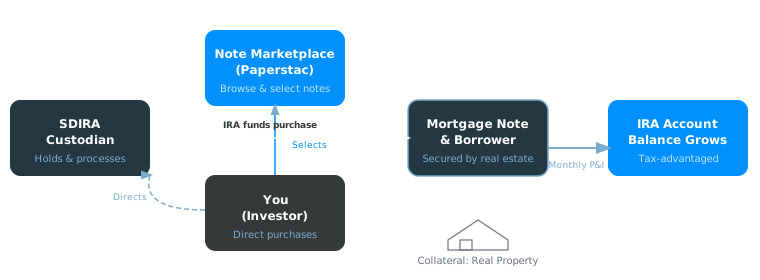
The Mechanics in Plain English
Here’s how the transaction actually works, step by step:
Open an account with an IRS-approved SDIRA custodian. Fund it via direct contribution, transfer from an existing IRA, or a 401(k) rollover from a former employer. A direct rollover is not taxable and carries no penalty.
Browse performing or non-performing mortgage notes on Paperstac’s marketplace. Review due diligence documents: the note, the mortgage/deed of trust, payment history, title report, and property value. See our mortgage note due diligence guide for a full checklist. The note must be purchased from a non-disqualified person.
Submit a Buy Direction Letter to your custodian with the note details. The custodian processes the purchase and wires funds from your IRA to the seller. The note and all legal documents are titled in the name of your IRA — not in your personal name.
The borrower makes monthly principal-and-interest payments directly to your custodian (or a note servicer). Payments are credited to your IRA account and grow tax-deferred or tax-free, depending on account type.
Any costs related to the note — servicing fees, legal costs, foreclosure expenses — must be paid from IRA funds. You cannot personally pay these costs and reimburse yourself; doing so is a prohibited transaction.
IRS Rules, Prohibited Transactions & What You Must Know
The IRS doesn’t prohibit self-directed IRA investing in mortgage notes. It prohibits specific types of transactions. Understanding the difference is essential — violations can cause the entire IRA to lose its tax-advantaged status, triggering immediate taxation of the full account balance plus penalties.
- Buy performing notes from unrelated sellers
- Purchase non-performing/discounted notes
- Buy first-lien or second-lien notes
- Purchase partial interests in notes
- Originate new loans to non-disqualified persons
- Use a note servicer to manage payments/defaults
- Partner with other (non-disqualified) investors
- Lending to yourself from your IRA
- Buying a note from your spouse, parents, or children
- Personally paying note-related expenses
- Personally collecting payments before sending to IRA
- Buying notes from a company you own 50%+
- Using IRA collateral for a personal loan
- Providing services to borrower for compensation
Getting Started: Your Step-by-Step Roadmap
Ready to put your retirement dollars to work in mortgage notes? Here’s how to move from zero to your first note purchase inside an SDIRA.
Before opening an account, understand how mortgage notes work — lien positions, LTV, note grading, performing vs. non-performing. Use Paperstac’s guide to buying mortgage notes online, the note investing red flags checklist, and the rest of the Paperstac blog to build your knowledge base.
Not all custodians allow alternative assets. Select one with experience in promissory notes and mortgage note transactions. Compare fees, customer service, and the speed of transaction processing. See our custodian list below.
Complete the custodian’s account application and provide a government-issued ID. Fund your account via a direct transfer from an existing IRA, a 401(k) rollover, or annual contributions. Direct rollovers are not taxable events.
Log in to Paperstac.com and filter notes by performance status, lien position, state, property type, and UPB (unpaid principal balance). Review all available due diligence materials and conduct your own independent analysis including property value verification. Our mortgage note due diligence guide walks through exactly what to check.
Once you’ve selected a note, complete your custodian’s Buy Direction Letter with the note details, seller information, purchase price, and documentation. All documents must be titled in the name of your IRA.
A professional loan servicer collects payments, manages borrower communication, and handles defaults on behalf of your IRA. This keeps you out of day-to-day operations and reduces prohibited transaction risk. The servicer fee is paid from IRA funds.
Monthly payments flow into your IRA account. Reinvest that income into additional notes to compound your returns. Over time, your IRA balance grows — tax-deferred or tax-free — without annual tax drag on the interest income.
Self-Directed IRA Companies We Work With
The custodian you choose matters. They must be comfortable with note transactions, process Buy Direction Letters efficiently, and understand how to title assets properly in the name of the IRA. Paperstac works with the following SDIRA companies:
Always verify current fee structures and available account types directly with each custodian before opening an account. This list is for informational purposes only and does not constitute a recommendation.
Real Investor Questions Answered
Frequently Asked Questions
Yes. A Self-Directed IRA can legally hold mortgage notes and other promissory notes secured by real estate. The IRS does not prohibit these investments — it only restricts certain transactions with disqualified persons. All income from the note flows tax-deferred (Traditional SDIRA) or tax-free (Roth SDIRA) back into your retirement account.
With a Traditional SDIRA, contributions may be tax-deductible and your investment grows tax-deferred — you pay taxes when you take distributions. With a Roth SDIRA, contributions are made with after-tax dollars, but qualified distributions are completely tax-free. If your note investments generate significant returns over time, a Roth SDIRA is often more advantageous.
Disqualified persons include you (the account holder), your spouse, lineal descendants (children, grandchildren), lineal ascendants (parents, grandparents), and any business entity in which you or these relatives own 50% or more. You cannot buy, sell, or lend to these individuals or entities through your SDIRA. See IRS Publication 590-A for the full definition.
Yes. SDIRAs can purchase both performing and non-performing mortgage notes, including deeply discounted notes. Buying at a discount increases your effective yield. The note must be purchased at arm’s length from a non-disqualified person, and all payments and proceeds must flow directly into the SDIRA.
If the borrower defaults, your SDIRA has the right to pursue foreclosure on the property securing the note. All costs associated with the foreclosure must be paid from the SDIRA’s funds — not your personal funds. Working with a note servicer makes this process smoother, as they can manage collections and default procedures on behalf of your IRA.
If you’ve left the employer who sponsored your 401(k), you can roll those funds into a Self-Directed IRA with no taxes or penalties via a direct rollover. Once in the SDIRA, you can invest in mortgage notes. A Solo 401(k) — for self-employed individuals — can also hold alternative assets including notes directly.
Generally, interest income from mortgage notes held in an SDIRA is not subject to UBIT. UBIT typically applies when debt-financing (non-recourse loans) is used to purchase assets inside the IRA. Standard note investing — where the IRA purchases the note outright with existing funds — typically falls outside UBIT. Always consult a qualified tax professional for your specific situation.
Paperstac is one of the leading online marketplaces for buying and selling mortgage notes. You can browse performing and non-performing notes, review due diligence documents, analyze note details, and execute transactions — all in one platform. Your SDIRA custodian processes the purchase once you select a note. Read our full guide on how to buy mortgage notes online to get started. Other sources include note brokers, direct seller outreach, and networking with real estate investors and banks selling off assets.
Ready to Buy Your First Note with Your IRA?
Paperstac is the leading marketplace for performing and non-performing mortgage notes. Browse the inventory, run your due diligence, and make your first SDIRA-funded purchase.
Browse Notes on Paperstac →Sources & References
- Directed IRA — Investment Types & SDIRA Promissory Notes. directedira.com. As of Q3 2025: $18.9T in total U.S. IRA assets.
- uDirect IRA Services — “Self-Directed IRAs Are Booming — Here’s What Investors Need to Know.” April 2025. Stat: 33% of investors now fully self-directed vs. 21% in 2019. udirectira.com
- Bankrate — “Best Self-Directed IRA (SDIRA) Companies in 2025.” June 2025. Equity Trust: $70B+ AUC. bankrate.com
- Equity Trust Company — Promissory Notes / Peer-to-Peer Lending. SDIRA Custodian since 1983. trustetc.com
- IRAR Trust Company — “Mortgage Notes: Invest in Real Estate with a Self-Directed IRA.” June 2025. iraresources.com
- IRA Innovations — “Holding Notes in a Self Directed IRA.” irainnovations.com
- The Mid Atlantic Fund — “Top Self-Directed IRA Trends Driving Growth Through 2025 and Beyond.” June 2025. SECURE 2.0 catch-up contribution updates. themidatlanticfund.com
- IRA Financial — “Pros and Cons of a Self-Directed IRA.” January 2026. Larry Fink / BlackRock 50/30/20 model reference. irafinancial.com
- Broad Financial — “Investing in Promissory Notes with a Self-Directed IRA.” October 2025. broadfinancial.com
- IRS — Publication 590-A: Contributions to Individual Retirement Arrangements. IRS.gov