
Ideas for a better investment
Investing in Business Notes: Unlocking a New Asset Class for Passive Income
Explore the rising asset class of business notes, unlocking passive income, fueled by the baby boomer ownership transfer.

10 min read
In the evolving world of debt investing, business notes are emerging as an exciting and dynamic asset class. With a wave of retiring baby boomer business owners—the so-called “silver tsunami”—there is an unprecedented opportunity for investors to participate in financing business acquisitions and franchise purchases. In this article, we dive deep into the world of business note investing with insights from Grant Ferguson and Nate Smith of Jumpstart Finance, featured on the Paperstac Podcast.
What Are Business Notes?
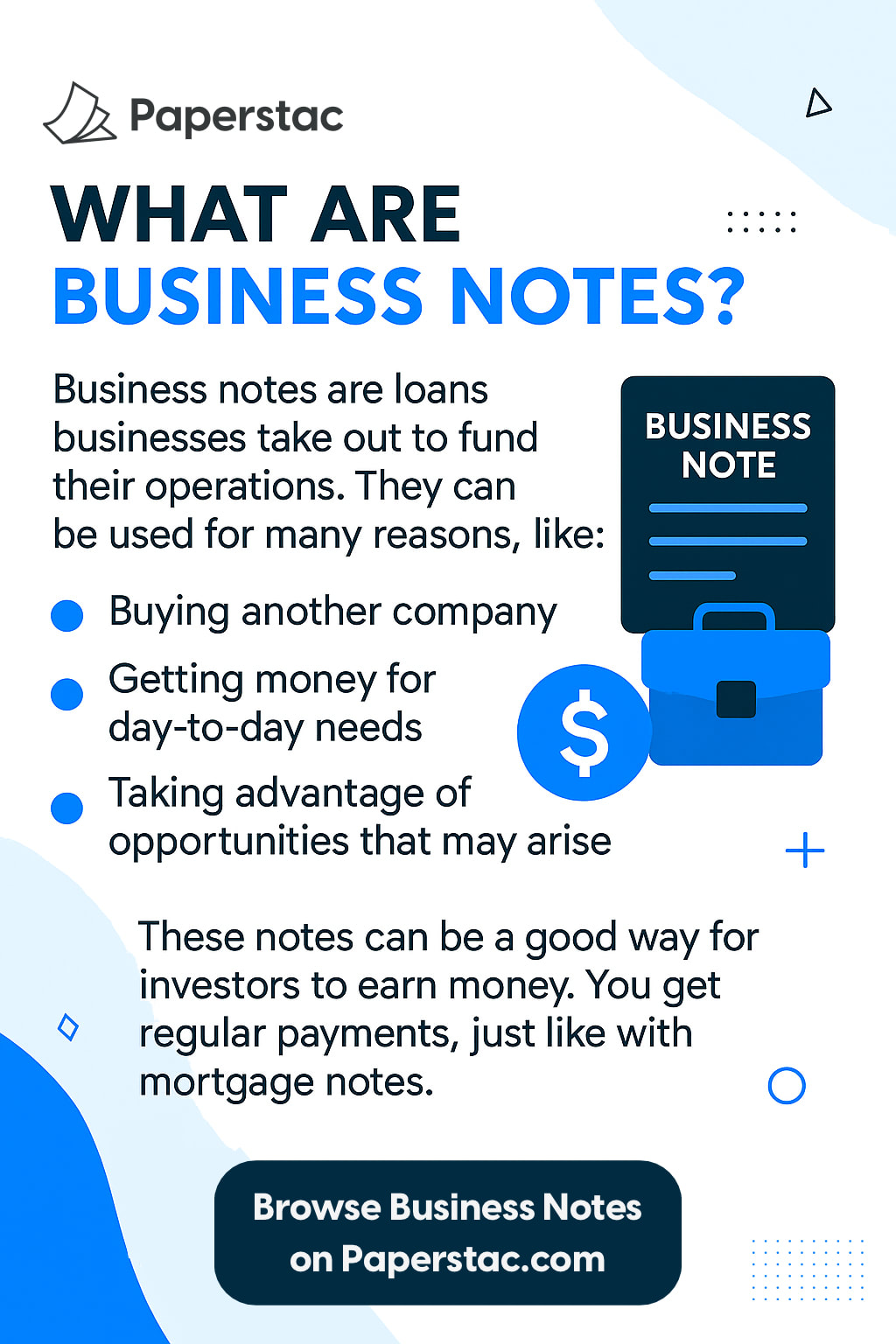
Simply put, business notes area type of promissory note created when financing is provided for the purchase of an existing business or franchise. Unlike traditional real estate debt, business notes finance the acquisition of operational companies, often involving seller financing or third-party lending. This asset class caters to buyers who do not have enough cash upfront to purchase a business outright and need financing solutions.
At its core, a business note is a legally binding promise to repay borrowed money under specified terms. Often used in private or seller-financed deals.
Grant and Nate from Jumpstart Finance specialize in this niche, focusing on loans typically ranging from $50,000 to $1 million, providing alternatives to conventional SBA 7(a) loans, which dominate the business acquisition financing market.
Common Uses of Business Notes
Business notes are surprisingly versatile. Some of the most frequent uses include:
- Business Acquisitions: Perhaps the most common example: when a business owner sells their company and offers financing to the buyer through a note. This arrangement—known as owner financing—lays out the repayment terms and helps the buyer avoid relying solely on bank loans.
- Equipment Purchases: Businesses sometimes borrow through notes to acquire expensive equipment (like trucks, medical devices, or construction machinery) needed to operate or expand.
- Working Capital: A business may issue a note to cover short-term cash flow needs, payroll, or operating expenses while waiting for receivables or seasonal revenue.
- Startup and Growth Funding: Startups often raise early-stage capital using convertible notes. These notes begin as debt but can later convert into equity when the company raises a larger financing round.
- Franchise Purchases: Buyers purchasing a franchise location often need supplementary financing, which may come in the form of a business note.
How Business Notes Work
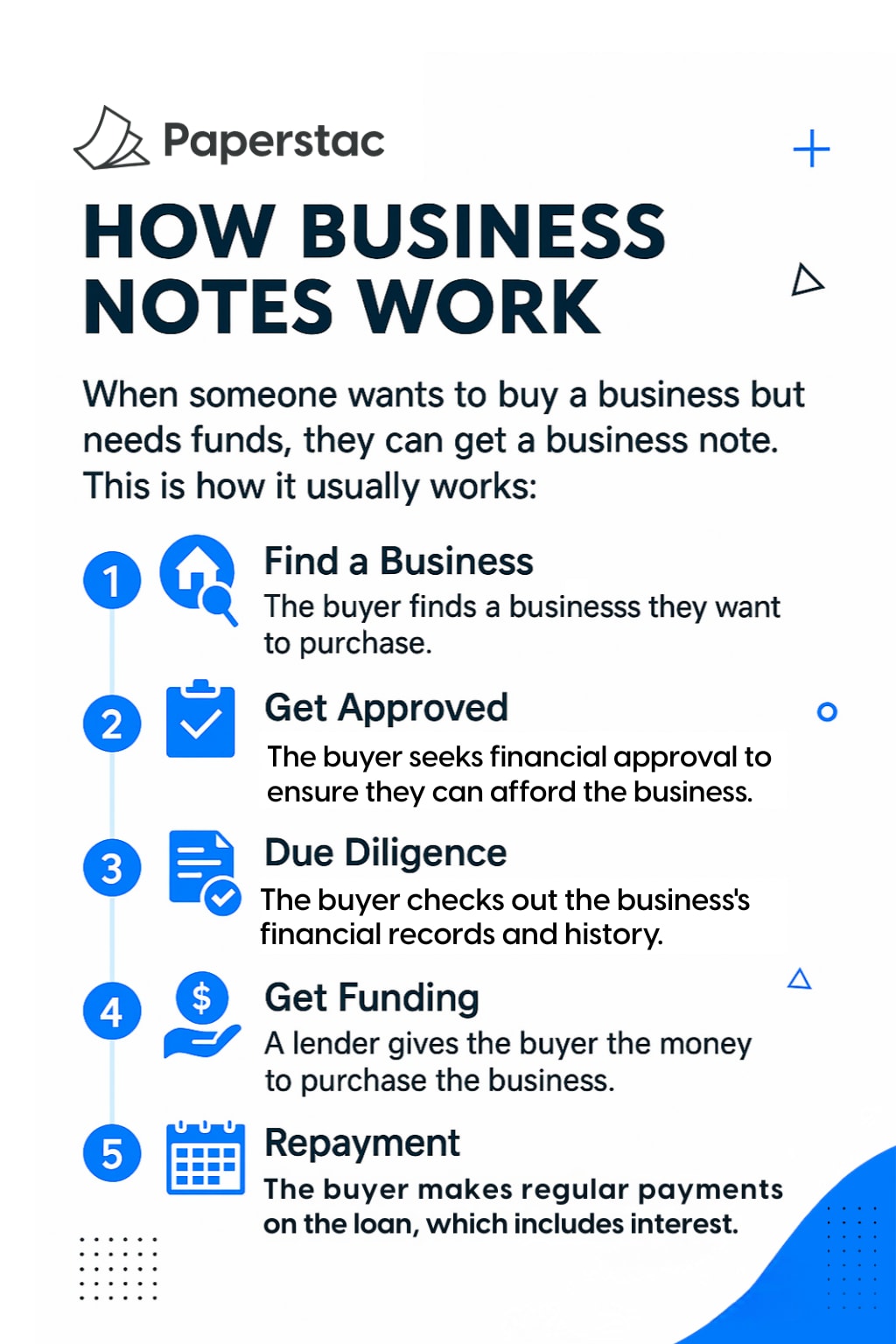
When someone wants to buy a business but needs funds, they can get a business note. This is how it usually works:
- Find a Business: The buyer finds a business they want to purchase.
- Get Approved: The buyer seeks financial approval to ensure they can afford the business.
- Due Diligence: The buyer checks out the business’s financial records and history.
- Get Funding: A lender, like Jumpstart Finance, gives the buyer the money to purchase the business.
- Repayment: The buyer makes regular payments on the loan, which includes interest.
The Silver Tsunami: A Massive Transfer of Business Ownership
One of the most compelling drivers behind the growth of business note investing is the impending transfer of ownership from retiring baby boomers. An estimated 8 to 10 million businesses are expected to change hands in the coming years, representing a staggering $10 trillion wealth transfer.
Many of these business owners have built profitable, cash-flowing companies but are ready to retire without successors in place. For buyers, this creates an opportunity to acquire established businesses, often with financing support.
Why Business Notes Are Gaining Popularity
Business notes are emerging as an increasingly attractive option for both buyers and investors. Several key trends are driving this growth:
1. Retiring Business Owners
Many baby boomers are reaching retirement age and looking to sell their businesses. Buyers often need financing to complete these transactions, and seller-financed business notes help bridge that gap.
Why It Matters: The so-called “silver tsunami” is expected to drive millions of small business sales in the coming years, with nearly $10 trillion in wealth transfer anticipated. This generational shift is creating a steady pipeline of opportunities for note financing.
2. SBA Loan Alternatives
While Small Business Administration (SBA) loans—particularly the 7(a) program—remain a common financing tool, they don’t always fit every deal. Business notes provide an alternative, often with more flexibility and faster execution.
Why It Matters: The SBA 7(a) market alone accounts for roughly $31 billion in lending volume, with an estimated $6 billion tied specifically to business transfers. This highlights both the scale of acquisition financing and the growing demand for alternatives outside of traditional bank loans.
3. A Developing Secondary Market
Traditionally, banks traded participations among themselves, but today a broader secondary market for business notes is emerging. This creates liquidity—allowing note holders to sell their positions for immediate cash rather than waiting years for full repayment.
Why It Matters: With standardized, properly underwritten business notes becoming available to non-bank investors, a new asset class is taking shape—opening the door to broader participation and investment strategies.
👉 In short: demographic shifts, financing gaps, and secondary market development are converging to make business notes one of the most compelling investment opportunities in today’s market.

How Jumpstart Finance Came to Be
Jumpstart Finance was born in September of last year from the merger of two competitors—AllC Funding and UFS—to combine complementary strengths and better serve this growing market. Nate Smith, originally from Australia, and Grant Ferguson, with a background in corporate banking and consulting, joined forces to create a platform that offers business acquisition and franchise purchase lending with institutional rigor.
Underwriting Business Notes: The Jockey and the Horse
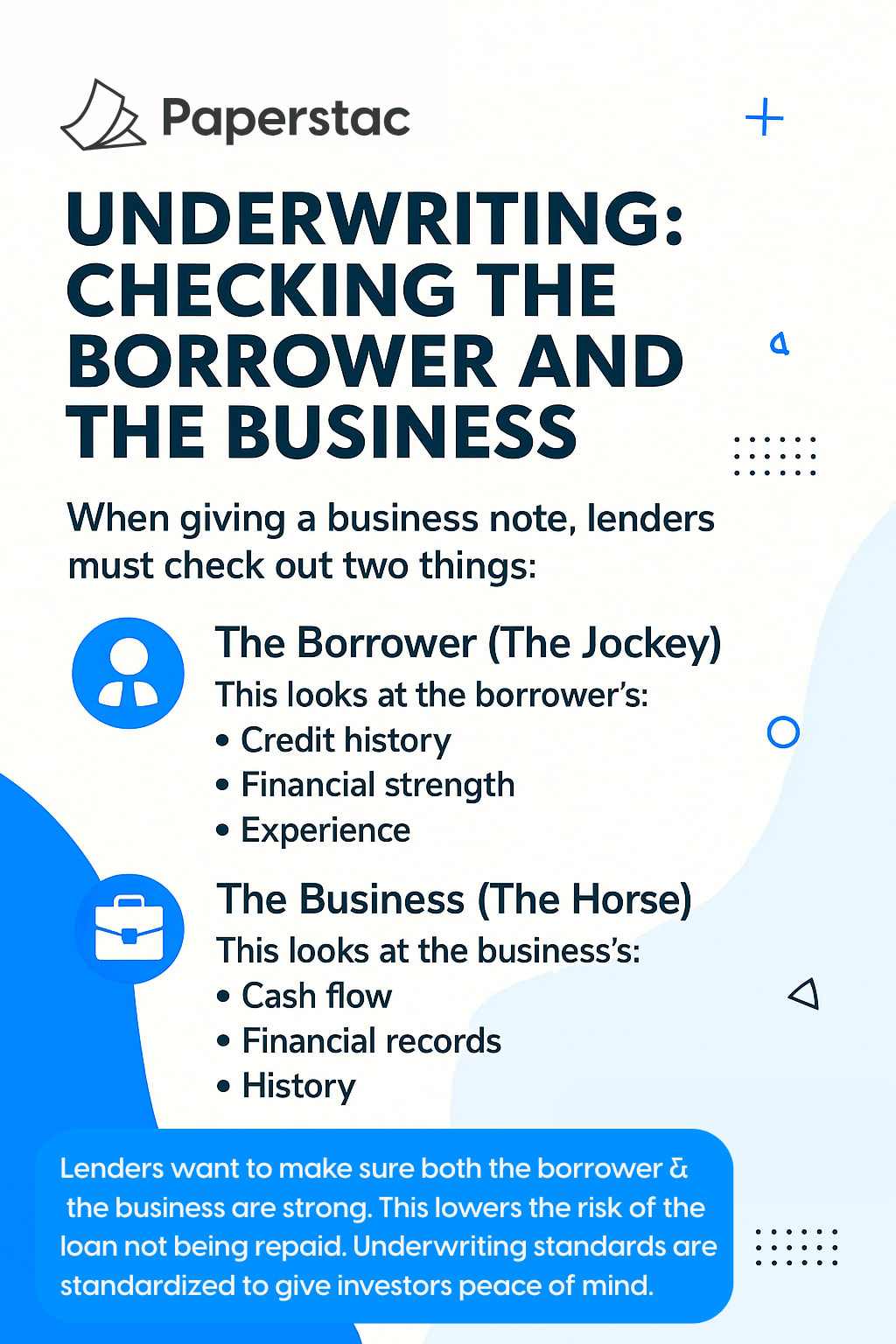
One of the unique aspects of business note underwriting is the metaphor of the “jockey and the horse.”
- The Horse: Represents the business itself. For acquisitions, lenders look at historical financials, tax returns, cash flow, and business performance to assess risk.
- The Jockey: Represents the borrower or business operator. Their creditworthiness, experience, and financial strength are critical, especially for startup franchises where business history is limited.
For established businesses, underwriting leans heavily on the horse’s past performance, while for franchises or startups, the jockey’s credentials carry more weight. Both elements are crucial to determining loan eligibility and terms.
Loan Terms, Interest Rates, and Servicing
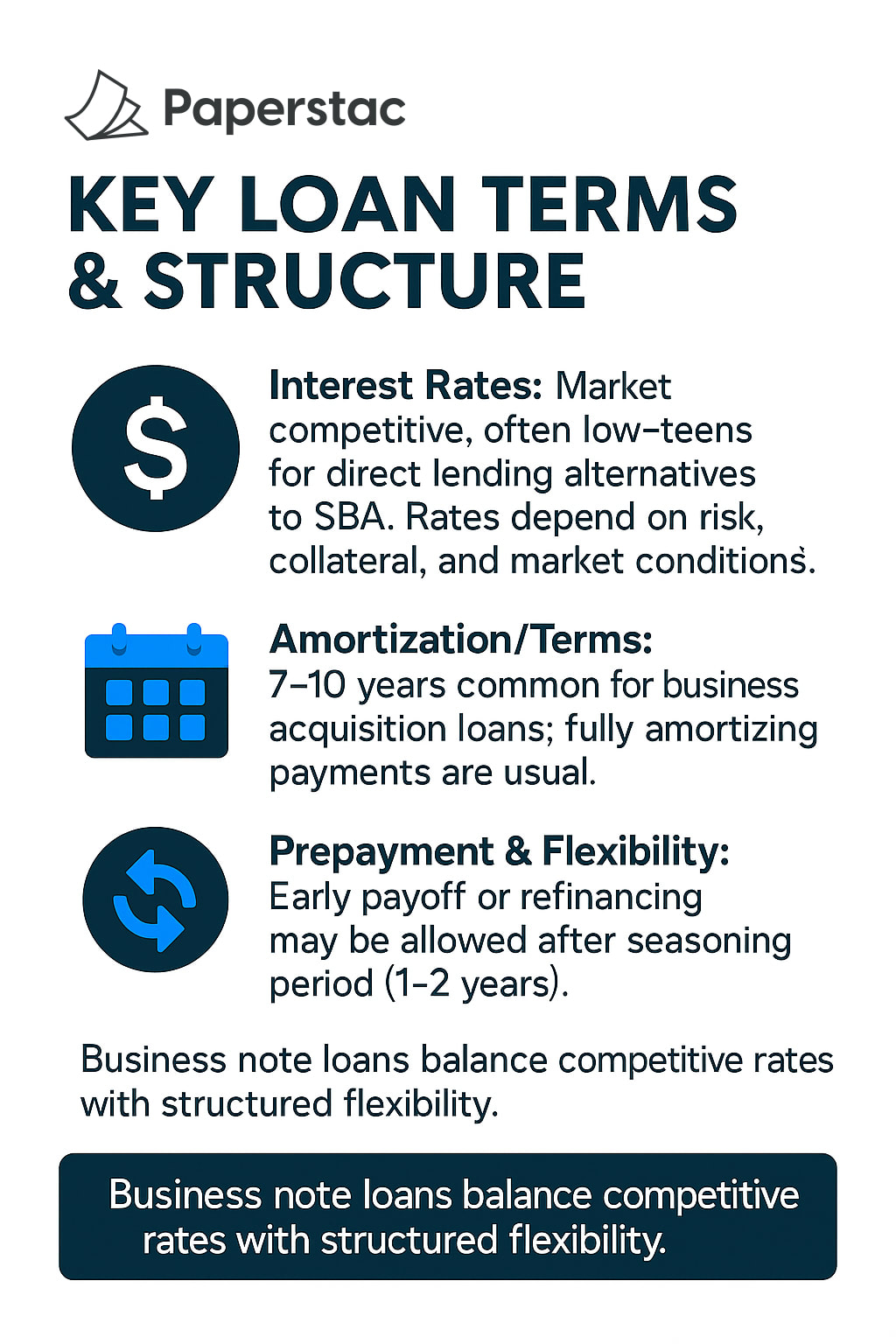
Business notes typically range from 7 to 10 years in term, structured as fully amortizing principal and interest loans. Interest rates usually fall in the low teens, competitive with SBA loans but offering faster processing and less red tape.
Servicing is an important consideration for note investors. Jumpstart Finance offers internal servicing platforms to handle payments, statements, tax documents, and delinquency follow-ups, ensuring a smooth experience for both borrowers and investors.
Risk Mitigation: Personal Guarantees and Collateral
Business notes are rigorously underwritten and backed by strong documentation. Loans generally include:
- Two personal guarantees from borrowers
- Collateral such as commercial or residential real estate, equipment, or other business assets
- UCC filings (Uniform Commercial Code liens) securing the business assets
- Escrow accounts holding a few months of payments as a safety buffer

This institutional-level underwriting aligns with FDIC-regulated sponsor banks, differentiating Jumpstart Finance from typical private lenders and providing investors with confidence in note quality.
| Risk Mitigation Feature | Details |
|---|---|
| Personal Guarantees | Two borrower guarantees ensure personal accountability and repayment incentive. |
| Collateral | Backed by real estate, equipment, or other tangible business assets. |
| UCC Filings | Secures the business assets under the Uniform Commercial Code framework. |
| Escrow Accounts | Reserve payments act as a buffer, reducing risk in case of short-term disruption. |
| Institutional-Grade Underwriting | Mirrors FDIC bank standards, elevating investor confidence and note quality. |
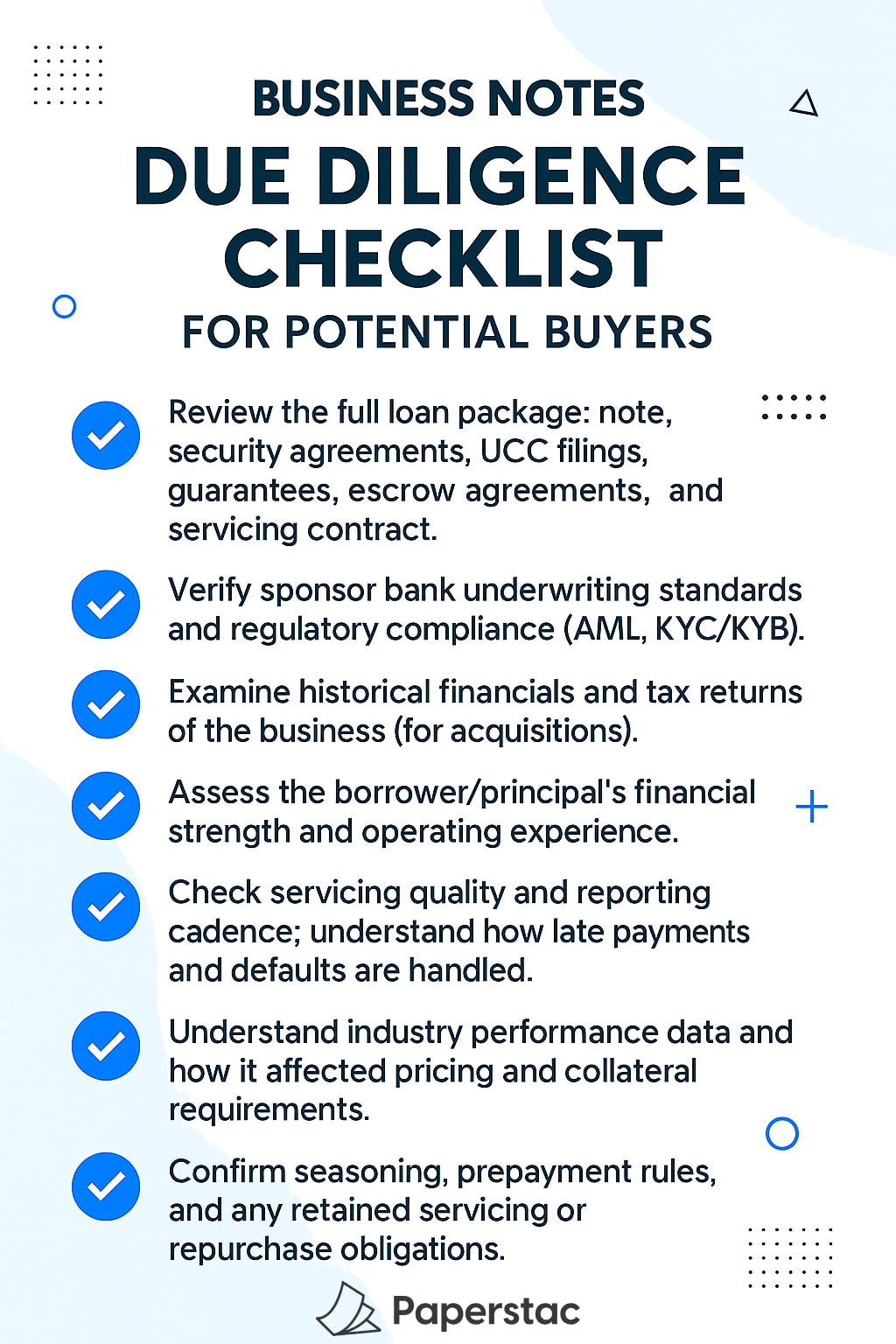
Documentation and risk mitigation
Institutional‑grade business notes include paperwork and protections that make them attractive to secondary market buyers.
Standardized, complete documentation: Consistency in loan packages speeds investor due diligence and improves tradability.
Personal guarantees: Most loans include one or more personal guarantees from principals—this provides recourse beyond the business.
UCC filings: A UCC (Uniform Commercial Code) filing gives the lender a first‑priority security interest in the business assets.
Collateral: Lenders may take commercial or residential real estate, equipment liens, or a blanket lien on the business.
Escrows and reserves: Lenders commonly hold several months’ payments in escrow to provide a buffer for early delinquencies.
Compliance & sponsor bank: Loans originated through relationships with an FDIC‑chartered sponsor bank must follow AML, KYC/KYB and meet institutional underwriting standards.
Secondary Market Opportunity for Business Notes
While mortgage notes have long had a robust secondary market, business notes have traditionally been traded mostly between banks. Jumpstart Finance and Paperstac are working to open this space to individual investors, creating liquidity and allowing sellers who offer owner financing to cash out by selling their notes on a secondary market.
This development unlocks new passive income opportunities, where investors can purchase performing business notes that generate monthly payments, similar to mortgage notes.
Industry Risk Tiers and Data-Driven Underwriting
Default rates vary by industry, with restaurants and retail generally carrying higher risk compared to business and commercial services. Jumpstart Finance leverages decades of SBA loan performance data to inform underwriting decisions, evaluating business “comps” to ensure loans pass a rigorous “smell and sniff” test.
Investors benefit from this data-driven approach, which helps mitigate risk and identify quality notes.
📊 Industry Risk Tiers (Based on SBA Data)
Secured vs. Unsecured Business Loans
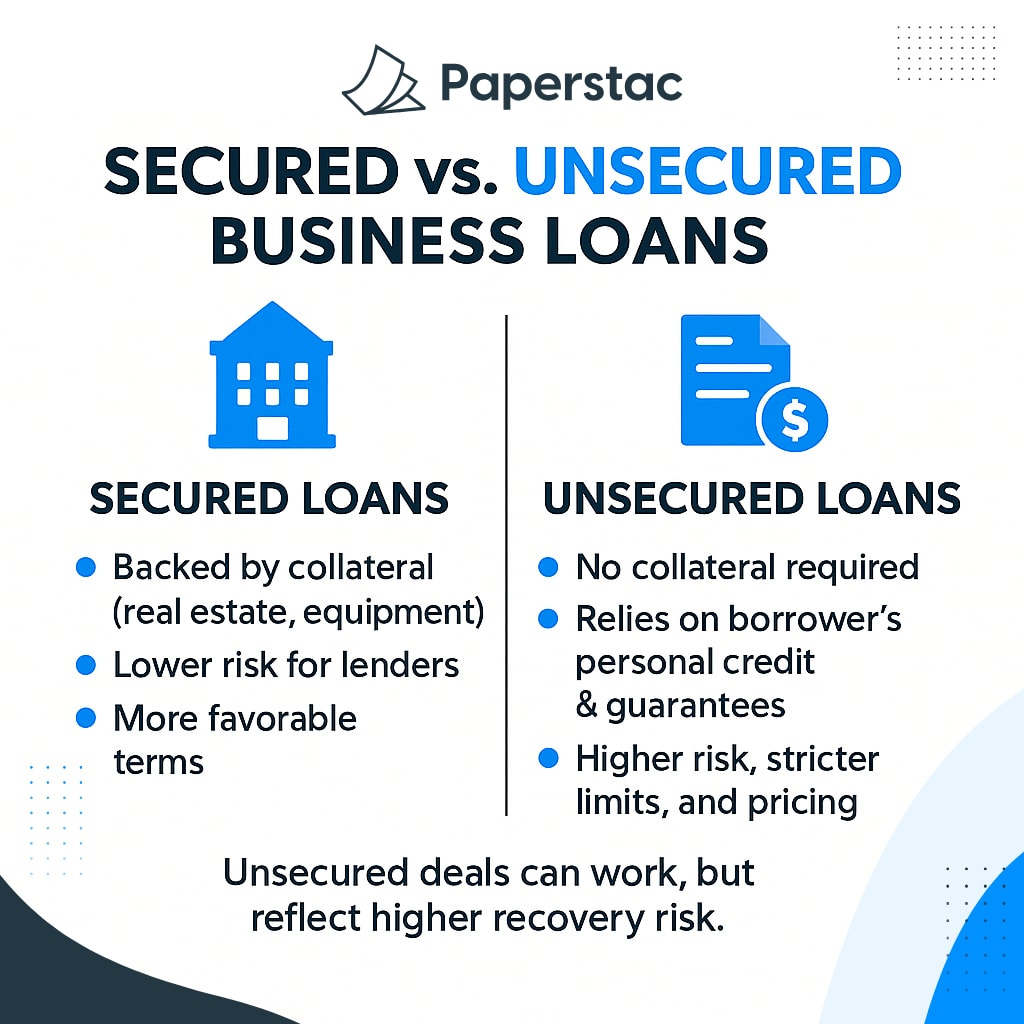
Not all borrowers have collateral to pledge. In such cases, unsecured loans rely more heavily on the borrower’s creditworthiness (“the jockey”). There are limits to unsecured lending amounts, but these loans still provide financing opportunities for qualified buyers without real estate or other assets.
| Feature | Secured Business Loans | Unsecured Business Loans |
|---|---|---|
| Backed By | Real estate, equipment, or assets | Borrower’s creditworthiness |
| Loan Size | Higher limits possible | Lower loan caps |
| Risk Profile | Lower risk due to collateral | Higher risk without tangible security |
| Underwriting Focus | Business and collateral value | “The Jockey” (borrower profile) |
Investor Liquidity and Private Credit Involvement
Beyond individual investors, private credit funds, family offices, and even private equity firms are increasingly attracted to business note investing. Jumpstart Finance offers opportunities for investors to participate pre-origination and benefit from residual payments through fund or SPV structures.
This expanding capital flow into the space further validates business notes as an emerging asset class for fixed income and passive income generation.
👤 Individual Investors
Seeking passive income from pre-underwritten business notes.
💼 Private Credit Funds
Participate via SPVs or fund models, adding diversification to portfolios.
🏛️ Family Offices
Attracted to steady cash flow and predictable returns.
📈 Private Equity Firms
Entering the market with larger capital and scalable strategies.
Conclusion: A Wealth of Opportunity in Business Note Investing
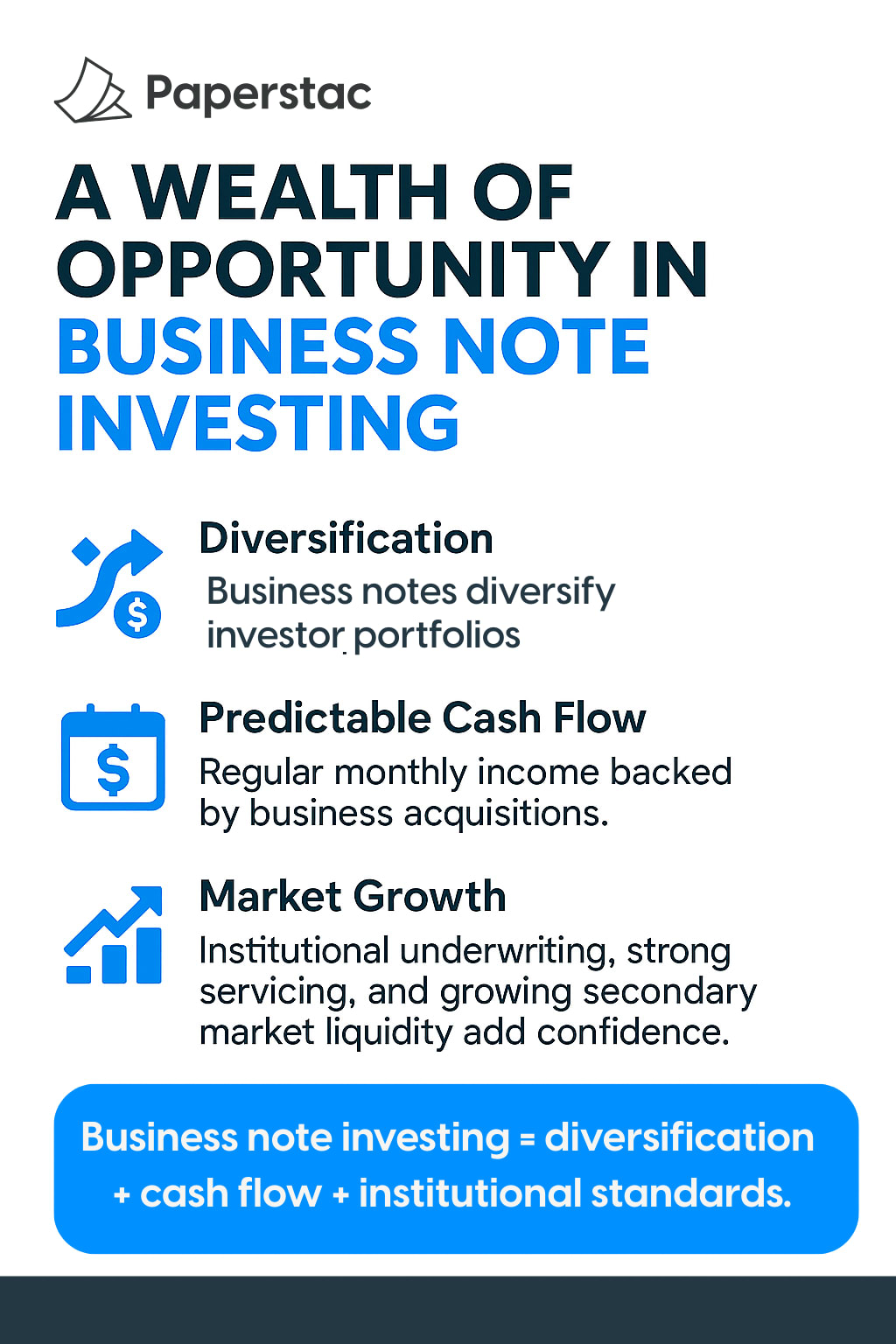
Business note investing is a promising and underexplored avenue for investors seeking diversification, predictable cash flow, and exposure to the thriving business acquisition market. With institutional underwriting standards, robust servicing, and growing secondary market liquidity, this asset class offers compelling benefits.
As Grant Ferguson and Nate Smith shared, the landscape is rich with opportunities—from direct lending to secondary market investments and private credit participation. Investors and note buyers are encouraged to learn more, perform due diligence, and explore this emerging field.
Business Notes: A Complementary Asset Class
Business notes complement mortgage paper as an asset class.
Institutional buyers already understand and trade business notes.
Access is expanding via standardized origination and secondary markets.
Business notes expand opportunities for note investors.

Frequently Asked Questions (FAQ)
What is a business note?
A business note is a loan made to finance the purchase of an existing business or franchise, often involving seller financing or third-party lending.
How does underwriting work for business notes?
Underwriting considers both the business (“horse”) and the borrower (“jockey”). For acquisitions, lenders analyze business financials and cash flow; for startups or franchises, they focus more on the borrower’s creditworthiness and experience.
What are typical loan terms and interest rates?
Business notes usually have terms of 7 to 10 years with interest rates in the low teens, structured as fully amortizing principal and interest loans.
Are business notes easy to service?
Yes, platforms like Jumpstart Finance provide internal servicing, handling payment collection, statements, tax documents, and delinquency management to simplify the process for investors.
Can individuals invest in business notes?
Yes, while banks have traditionally traded business notes, platforms like Paperstac are opening this market to individual investors, providing access to performing notes and secondary market liquidity.
Is there a secondary market for business notes?
Yes, although historically limited to bank-to-bank trades, the secondary market is expanding to include investors and private credit funds, enhancing liquidity and investment opportunities.
What industries carry higher risk?
Industries like restaurants and retail tend to have higher default rates, while sectors such as commercial services generally have lower risk. Underwriting leverages decades of industry data to assess risk.
Can business notes be unsecured?
Yes, unsecured loans are available but rely more heavily on the borrower’s creditworthiness and have lending limits.
How can investors participate in business note lending?
Investors can buy performing notes on secondary markets, participate in private credit funds, or provide liquidity pre-origination through fund or SPV structures.
Explore the Paperstac Platform |
|
Browse notes for sale. |
| Click me |
Explore a Few Educational Resources Below
Note Investing Education
For a deeper understanding of note investing, visit the Paperstac Academy for educational resources tailored for beginners. NEW Monthly Subscription Available.
