Ideas for a better investment
Your Guide to Note Investing Jargon & Slang
Dive into the essential note investing jargon with our comprehensive guide. Learn key terms and phrases every note investor should know.

11 min read
This blog post is based on the Paperstac podcast episode titled: Learning Note Investing Jargon and Slang Terms
In the world of note investing, understanding real estate jargon and slang can significantly enhance your knowledge and confidence. In this comprehensive guide, we will break down essential note investing terms and phrases used in the industry, ensuring you’re well-equipped for conversations and transactions.
📚 Introduction
Understanding the language of note investing is essential for success in this field. This guide will provide insights into key terms and phrases that every investor should know.
📖 Introduction to Note Investing Jargon
As Brett and Rick dive into note investing, they emphasize the importance of understanding industry jargon. Knowing these terms can enhance your confidence and decision-making.
Common Note Investing Terms to Know
Stay tuned as they break down these terms in future episodes.
🎨 Understanding “Color” in Note Investing
In note investing, “color” refers to the additional information or context about a loan or investment. It’s essential for making informed decisions.
What Does “Color” Provide?
When someone asks for more “color,” they seek clarity on specific details. This could include:
- Background on the portfolio
- Details about the seller
- Pricing insights
Having this information helps investors understand the risks and opportunities associated with their investments.
💰 What is the “Coupon Rate”?
The coupon rate is a vital term in note investing. It represents the interest rate the borrower pays on a loan, expressed as a percentage of the loan’s face value.
Importance of the Coupon Rate
This rate determines the income an investor receives from the note. Key points include:
- Influences cash flow
- Impacts investment returns
- Affects market value of the note
Understanding the coupon rate is crucial for evaluating the profitability of a note investment.

📊 Explaining “WAC” (Weighted Average Coupon)
The Weighted Average Coupon (WAC) is an important metric in note investing. It represents the average interest rate of a pool of loans, weighted by their respective balances.
Why WAC Matters
WAC provides a clearer picture of the overall yield from a collection of loans. Consider these points:
- Helps assess portfolio performance
- Indicates risk levels
- Guides investment strategies
Investors use WAC to compare different investment opportunities effectively.
✂️ “Coupon Clipping” in Note Investing
“Coupon clipping” is a term used in note investing to describe a specific strategy. It refers to investors who purchase performing loans to earn interest payments.
Who are Coupon Clippers?
Coupon clippers typically focus on loans that provide steady cash flow. Key characteristics include:
- Buying performing loans
- Seeking high coupon rates
- Building an income stream
These investors aim to fill their portfolios with reliable income-generating assets.

💵 Defining “Strike Price”
The “strike price” is a critical term in note investing. It indicates the price at which an asset will be sold or bought.
Understanding the Strike Price
This price serves as a reference point in negotiations. Important aspects include:
- Starting point for offers
- Negotiation basis
- Final sale price
Knowing the strike price helps investors make informed decisions during transactions.
🔄 What Does “Fade” Mean?
In note investing, “fade” refers to the reduction of an initial bid after conducting due diligence. This term reflects a cautious approach to bidding.
When to Fade a Bid
Investors might choose to fade their bid based on new information. Consider these scenarios:
- Identifying missing documentation
- Spotting payment history issues
- Adjusting expectations based on findings
Fading a bid showcases an investor’s adaptability and risk management skills.
📊 Understanding “Par” in Note Investing
In note investing, “par” refers to the face value of a loan or security. It represents the amount that will be repaid to the investor at maturity. This value is essential in evaluating the potential return on investment and making informed decisions.
Key Aspects of Par Value: Note Industry Jargon Explained
Understanding par is crucial for evaluating investments. Here are some important points to consider:
1. Determines Investment Worth
• Definition: Par value is the nominal or face value of a note, loan, or security.
• Impact: It helps investors determine the worth of their investment. Knowing the par value allows investors to gauge if they are buying the note at a discount, at par, or at a premium.
• Example: If you purchase a note with a par value of $100,000 for $95,000, you are buying it at a discount. Conversely, buying it for $105,000 means purchasing at a premium.
2. Influences Pricing Strategies
• Pricing Decisions: Par value influences how notes are priced in the market. Investors and sellers use par as a benchmark to set prices.
• Market Perception: Notes sold below par are often seen as having higher risk or lower performance, while those sold above par might indicate stronger credit quality or lower risk.
• Example: A note selling at 90% of par might attract investors looking for potential appreciation, while a note selling at 110% of par might appeal to those seeking stable returns.
3. Relates to Interest Rates
• Yield Calculation: The relationship between par value and the purchase price affects the yield of the investment. Buying at a discount increases yield, while buying at a premium decreases it.
• Interest Rate Sensitivity: The interest rate environment can impact how par value influences note prices. In a rising rate environment, notes might sell below par as their fixed interest payments become less attractive.
• Example: A note with a par value of $100,000 and a 5% interest rate will have different attractiveness depending on whether the market interest rates are above or below 5%.
4. Risk Assessment
• Creditworthiness: Par value helps assess the creditworthiness of the borrower. Notes trading significantly below par might signal potential credit issues.
• Investment Strategy: Investors use par value to assess the risk-reward ratio of an investment. Higher discounts might offer higher returns but come with increased risk.
• Example: Investing in a note trading at 70% of par might offer higher returns if the borrower recovers, but also carries higher default risk.
5. Secondary Market Transactions
• Liquidity Considerations: Par value plays a role in the liquidity of notes in the secondary market. Notes closer to par value are often easier to buy and sell.
• Market Dynamics: Understanding par value helps investors navigate the secondary market, ensuring they make informed buying or selling decisions.
• Example: An investor might prefer notes trading near par for easier exit strategies, while others might target significant discounts for higher potential gains.
By grasping these key aspects, investors can better navigate the complexities of note investing, optimize their investment strategies, and achieve their financial goals.
🏦 Note Investing Jargon & Abbreviations | NPL, RPL, and PLS: Types of Loans
Note investing features different loan types, each with unique characteristics. Understanding these note investing terms and loan types helps investors assess risks and opportunities.
Types of Loans Explained
- NPL: Non-Performing Loans
- RPL: Re-Performing Loans
- PLS: Performing Loans
NPLs are loans that are 90 days past due, while RPLs have returned to performing status. PLS are loans that are consistently making payments.
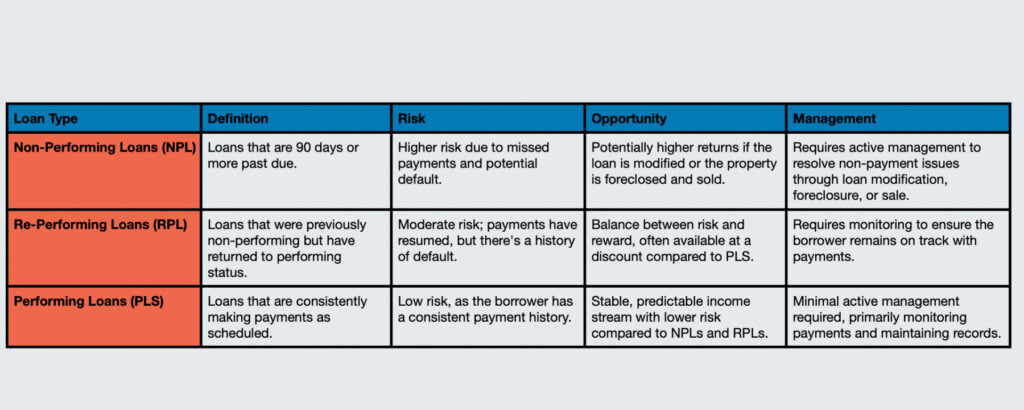
Non-Performing Loans (NPL):
• Definition: Loans that are 90 days or more past due.
• Risk: Higher risk compared to performing loans due to missed payments and potential default.
• Opportunity: Investors may purchase at a significant discount, allowing for potentially higher returns if the loan is modified or the property is foreclosed and sold.
• Management: Requires active management to resolve non-payment issues through loan modification, foreclosure, or sale.
Re-Performing Loans (RPL):
• Definition: Loans that were previously non-performing but have returned to performing status.
• Risk: Moderate risk compared to performing and non-performing loans; though payments have resumed, there’s a history of default, which might recur.
• Opportunity: Offers a balance between risk and reward, often available at a discount compared to PLS, with potential for steady income if the borrower continues to perform.
• Management: Requires monitoring to ensure the borrower remains on track with payments.
Performing Loans (PLS):
• Definition: Loans that are consistently making payments as scheduled.
• Risk: Low risk, as the borrower has a consistent payment history.
• Opportunity: Provides a stable, predictable income stream with lower risk compared to NPLs and RPLs.
• Management: Minimal active management required, primarily monitoring payments and maintaining records.
🔍 What is a BPO (Broker Price Opinion)?
A Broker Price Opinion (BPO) is an estimate of a property’s value provided by a real estate broker. It helps investors gauge the market value of a property.
Why BPO Matters
BPOs are essential for making informed investment decisions. Key reasons to obtain a BPO include:
- Assessing property value
- Guiding purchase decisions
- Understanding market trends
📜 What is an O&E (Ownership and Encumbrance Report)?
An Ownership and Encumbrance (O&E) Report is a document that provides vital information about a property. It acts like a title report, revealing details about the property’s title and any associated liens.

Key Features of an O&E Report
- Shows ownership history
- Lists any liens on the property
- Includes tax information
Understanding this report is crucial for assessing potential risks before investing in a property.
🏠 PMI and Force-Placed Insurance
Private Mortgage Insurance (PMI) is typically required when a borrower has a down payment of less than 20%. It protects the lender in case of default.
Note Investing Jargon & Terms: Understanding Force-Placed Insurance
Force-Placed Insurance (FPI) is coverage that lenders obtain when borrowers fail to maintain their insurance. Important aspects include:
- Protects lender’s investment
- Can be costly for borrowers
- Triggered by lack of insurance
Both PMI and FPI are essential concepts in the realm of mortgage lending.
📈 LTV and Other Common Acronyms
LTV stands for Loan-to-Value ratio, a key metric in real estate financing. It compares the loan amount to the property’s value.
Importance of LTV
A higher LTV ratio indicates higher risk for lenders. Common acronyms related to LTV include:
- PMI: Private Mortgage Insurance
- FPI: Force-Placed Insurance
Understanding these acronyms helps clarify the financial aspects of real estate investments.
🤝 Understanding JV (Joint Venture)
A Joint Venture (JV) is a partnership where two or more parties collaborate on a project while sharing resources and risks. This arrangement is common in note investing.
Key Characteristics of a JV
- Shared financial contributions
- Division of labor and responsibilities
- Potential for profit sharing
In a JV, one party may provide capital while another handles operations, creating a balanced partnership.
🌱 What Does “Seasoning” Mean?
In note investing, “seasoning” refers to the age of a loan and its payment history. This term helps investors assess the reliability of a note.
Aspects of Seasoning
- Indicates loan maturity
- Reflects payment history
- Measured in months or years
Understanding the seasoning of a loan can influence investment decisions and risk assessments.
📚 Knowledge Base with Note Investing Terms
A robust knowledge base is essential for note investors. It provides access to definitions, acronyms, and explanations of industry jargon.
Why Use a Knowledge Base?
- Enhances understanding of complex terms
- Supports informed decision-making
- Offers downloadable glossaries
Visit the Paperstac Knowledge Base for valuable information and resources.
🛠️ Other Important Note Investing Jargon: Scratch and Dent, Exit Strategy, Workout
In note investing, certain terms are crucial for understanding the nuances of transactions. Three important terms are “scratch and dent,” “exit strategy”, and “workout”.
Scratch and Dent
This term refers to minor issues with loan paperwork. Examples include:
- Missing signatures
- Incomplete documents
- High-cost loans
These loans can still perform but may require extra attention.
Exit Strategy
Your exit strategy outlines how you’ll get out of an investment. Common strategies include:
- Reselling the note
- Refinancing
- Holding until maturity
Workout
This term deals with loss mitigation. It involves strategies for dealing with non-performing loans. Key aspects include:
- Working with borrowers
- Negotiating payment plans
- Assessing loan modifications

🏫 Visit Paperstac Academy
If you’re eager to learn more about note investing, the Paperstac Academy is the perfect place to start. This comprehensive course offers essential insights for beginners.

Purchase Notes on Paperstac
Ready to invest? You can browse and purchase mortgage notes directly through Paperstac. Our note investing platform simplifies the buying and selling process.
For more education, visit Paperstac Academy, and to sell or buy mortgage notes on a mortgage note trading platform, visit Paperstac.com.

❓ FAQ
As you dive into note investing, you may have questions. Here are some frequently asked questions:
What is a scratch and dent loan?
A scratch and dent loan has minor paperwork issues but can still perform.
How do I develop an exit strategy?
Your exit strategy should outline your plans for selling or refinancing the loan.
What does workout mean in note investing?
A workout refers to strategies for managing non-performing loans and working with borrowers.
If you have more questions, please leave them in the comments!

Ready to embark on your note investment journey?
Visit Paperstac to explore these strategies and take your first steps toward financial success!
Thank You For Reading
We hope you enjoyed reading this article from the Paperstac Blog! Don’t hesitate to contact jessica@paperstac.com with any mortgage note industry topics or collaboration inquiries you want us to cover on the Paperstac blog.

Paperstac
We invite you to visit our website to gain a deeper understanding of our platform, its features, and the incredible team behind it and to explore how it can benefit you.
For more information about us, please visit our website: https://paperstac.com/about.
Share This Article
Don’t forget to share this article on your favorite social media platforms and with others you feel can benefit from it.