
Ideas for a better investment
Performing vs. Non-Performing Mortgage Notes: Which Should You Buy?
What's the difference between performing and non-performing mortgage notes? Compare risk profiles, yield expectations (8–14%+ vs 15–30%+), exit strategies, and find out which type fits your investment goals.

10 min read
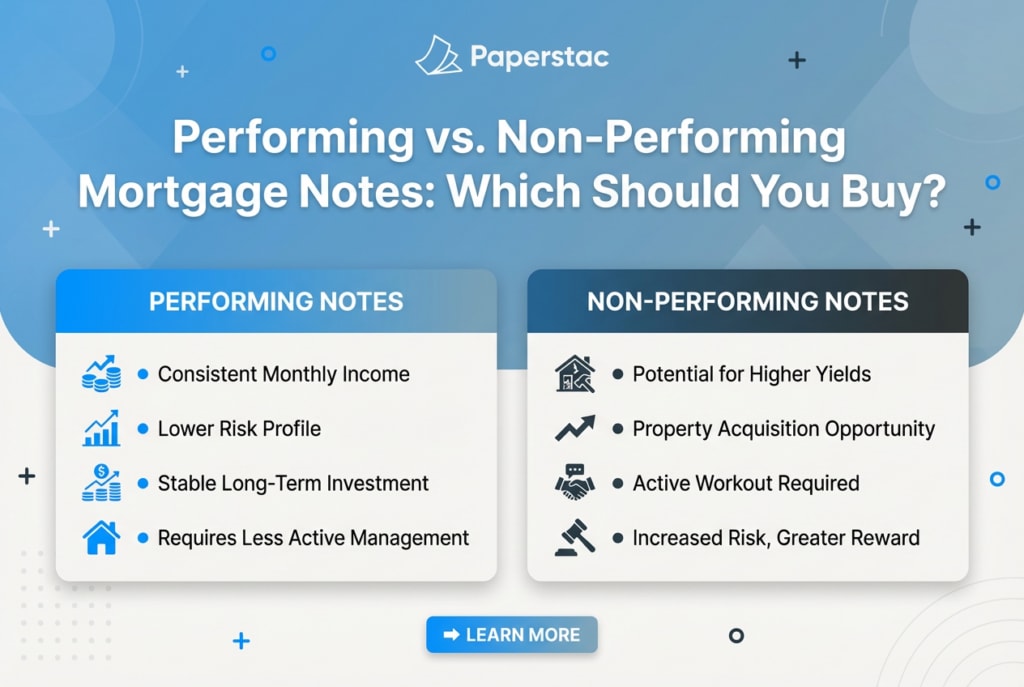
If you are researching performing vs. non-performing mortgage notes, you are already asking the right question. When you browse the Paperstac marketplace, these two note categories will define every investment decision you make — and understanding the difference between a performing note and a non-performing note (NPL) is the single most important concept in mortgage note investing. Both are real estate-backed debt instruments, but they serve entirely different investor profiles, carry different risk levels, and demand completely different strategies.
Think of it this way: a performing note is like buying a dividend-paying bond — steady, predictable, and passive. A non-performing note is like acquiring a distressed asset at a deep discount with multiple paths to profit. Neither is inherently superior. The right choice comes down to your experience, available capital, time horizon, and appetite for active management.
Key Takeaways
- A performing note is one where the borrower is current on payments (<30 days past due) — it delivers immediate monthly income from Day 1.
- A non-performing note (NPL) is 90+ days delinquent — no payments flow in, but you buy at a steep discount (30–65¢ on the dollar) and profit through active resolution.
- Performing notes typically yield 8–14%+ annualized; NPLs can yield 15–30%+ on a successful resolution.
- Both note types are secured by real property — you are never exposed to a total loss, only to time and execution complexity.
- NPL risk is classified as medium (not high) because the collateral provides a recovery path even if the borrower never pays again.
- Foreclosure timelines vary dramatically by state — certain judicial states can take 1–3 years, which is the primary timeline risk for NPL investors.
- It is usually recommended that new investors start with 1–3 performing notes to learn the mechanics before taking on NPL resolution strategies.
What Are Performing and Non-Performing Mortgage Notes?
A performing mortgage note is one where the borrower is current on their contractual payments — typically defined as less than 30 days past due. The investor receives consistent, predictable monthly income from Day 1, with the property serving as collateral.
A non-performing mortgage note (NPL) is one where the borrower has stopped making payments, typically 90 or more days past due. No payments are flowing to the investor. The note is purchased at a steep discount, and the investor must take action to resolve the situation and generate a return.
How Do Performing and Non-Performing Notes Compare Side by Side?
Cash Flow First
- Borrower is current (<30 days past due)
- Immediate monthly income from Day 1
- Priced at 80–95¢ on the dollar (UPB)
- Typical yield: 8–14%+ annualized
- Lower risk, lower upside
- Ideal for passive, income-focused investors
- Simpler asset management required
Discount + Strategy
- Borrower is 90+ days delinquent
- No payments — requires active resolution
- Priced at 30–65¢ on the dollar (UPB)
- Potential yield: 15–30%+ on resolution
- Medium risk — real estate collateral limits downside
- Requires experience and active management
- Multiple exit paths to choose from
| Attribute | Performing Note | Non-Performing Note |
|---|---|---|
| Payment Status | Current (<30 days past due) | Delinquent (90+ days past due) |
| Typical Purchase Price | 80–95% of UPB | 30–65% of UPB |
| Income Timeline | Immediate (Day 1) | Delayed until resolution — but real estate collateral ensures a recovery path even without borrower payments |
| Expected Yield | 8–14%+ annualized | 15–30%+ (if resolved successfully) |
| Management Intensity | Low — servicer manages payment collection, escrow & reporting; investor directs any workout if borrower goes delinquent | Medium — active negotiation & strategy required, but collateral backstop limits total exposure |
| Primary Risk | Borrower stops paying (becomes NPL) | Execution complexity & timeline — not capital loss, since real estate collateral provides recovery path |
| Best For | Passive income investors, IRA holders | Active investors, turnaround specialists |
| Due Diligence Focus | Payment history, property value, LTV | Equity position, borrower situation, state laws |
What Is the Risk Profile of Each Note Type?
Every investment carries risk — the key is understanding what kind of risk you are taking on and whether it is appropriate for your situation. Unlike stocks or unsecured debt, mortgage notes are backed by real property. That collateral fundamentally changes the risk equation: even in a worst-case scenario, you can foreclose, take title, and sell the asset to recoup your investment. You are not exposed to a zero — you are exposed to a timeline.
Performing Notes
Main risk: borrower default. Mitigated by low LTV, payment history, and real estate collateral. Servicer handles day-to-day — very hands-off.
Non-Performing Notes
Execution complexity and foreclosure timelines (up to 1–3 years in judicial states) are the primary risks. Real estate collateral limits downside — worst case: foreclose and sell.
Why NPLs are Medium — not High: Unlike stocks or unsecured lending, your investment is secured by a physical property. If the borrower never pays again, you can foreclose, take title, and sell the real estate to recover your capital. The risk is not loss of principal — it is time, costs, and execution complexity. That is a fundamentally different risk profile than equity markets where a position can go to zero.
Key Risk Factors to Watch
| Risk Factor | Performing Note Impact | Non-Performing Note Impact |
|---|---|---|
| Borrower Default | Note converts to NPL; requires restructuring | Already defaulted — this is the starting point |
| Property Value Decline | Reduces equity cushion; LTV risk rises | Critical — thin equity makes resolution harder |
| Foreclosure Timeline | Low relevance if borrower stays current | Major factor — judicial states can take 1–3 years |
| Property Condition | Moderate — borrower is motivated to maintain | Medium — vacant properties need monitoring, but collateral can be recovered and sold even in poor condition |
| Title / Lien Issues | Discovered in due diligence; manageable | Critical — junior liens can complicate foreclosure |
| Interest Rate Risk | Fixed rates mean stable payment streams | Less relevant since income is already disrupted |
The #1 NPL Rule: Always calculate your equity cushion before buying. If the property is worth $100,000 and you buy the note (UPB $80,000) for $45,000 — you have a $55,000 equity buffer even in a worst-case foreclosure. That cushion is what keeps NPL risk at medium rather than high. Buy right, and the real estate does the heavy lifting.
What Kind of Returns Can I Expect From Performing vs. Non-Performing?
*Illustrative only. Actual returns depend on purchase price, resolution timeline, state laws, and property conditions. Not investment advice.
The chart illustrates why non-performing notes attract sophisticated investors — the potential return spread over performing notes is substantial. However, those returns are not guaranteed and depend entirely on the investor’s ability to successfully resolve the situation.
What Are the Exit Strategies for Each Note Type?
Performing Note Exit Strategies
Hold to Maturity
Collect monthly payments for the life of the loan. Maximum yield if the borrower pays off on schedule.
PerformingSell at a Premium
After 12+ months of seasoning, resell the performing note at a lower yield (higher price) to another investor.
PerformingDiscount Payoff
Offer the borrower a discounted payoff to retire the loan early. Works well when borrower wants to refinance.
BothNon-Performing Note Exit Strategies
Loan Modification
Negotiate new terms with the borrower (lower rate, extended term, capitalized arrears). Note re-performs and regains value.
NPLShort Sale
Borrower sells property below UPB, lender (you) accepts less than full balance. Clean exit — avoids foreclosure costs and timeline.
NPLDeed in Lieu
Borrower voluntarily transfers title to you in exchange for debt forgiveness. Faster and cheaper than foreclosure.
NPLForeclose & Sell REO
Last resort if no other resolution works. Take title via foreclosure, rehabilitate if needed, sell the property as REO. Note: judicial states can take 1–3 years.
NPLThe Re-Perform Strategy: The most profitable NPL outcome is a successful loan modification. A note purchased at 50¢ on the dollar that is successfully re-performing for 12 months can be resold to a performing note investor at 80–90¢ — generating a 30–80% return without ever touching the property.
What Are Sub-Performing Notes — and Where Do They Fit?
A sub-performing mortgage note is one where the borrower is making some payments but is inconsistent — typically 30–89 days past due. The note is not fully performing, but the borrower has not fully abandoned their obligation. These notes trade at a moderate discount between performing and non-performing prices.
Sub-performing notes are often overlooked by investors who focus exclusively on one end of the spectrum. They can represent an attractive middle ground:
- Purchased at a discount to performing notes (less competition)
- Borrower still engaged — higher chance of modification success than true NPLs
- Less complexity than deeply distressed non-performing notes
- Can quickly re-perform with minor borrower outreach or payment plan adjustments
- More discounted than performing, providing better yield at purchase
Which Type of Mortgage Note Is Right for My Investment Goals?
The answer depends on four core factors: your experience level, available time, risk tolerance, and investment objective.
Choose Performing Notes If…
- You want predictable monthly cash flow
- You are investing through a self-directed IRA
- You are new to note investing
- You want a truly passive investment
- You have lower risk tolerance
- You prefer not to interact with borrowers
- You want an easier due diligence process
Choose Non-Performing Notes If…
- You want the highest potential returns
- You have real estate or legal experience
- You can afford to wait 6–24 months for a return
- You are comfortable with negotiation
- You understand your state’s foreclosure laws
- You want multiple exit strategy options
- You have the capital to absorb unexpected costs
Paperstac Recommendation: If you are new to note investing, start with 1–3 performing notes on Paperstac. Learn the mechanics — servicing, collateral files, payment tracking — before adding the complexity of non-performing resolution strategies.